


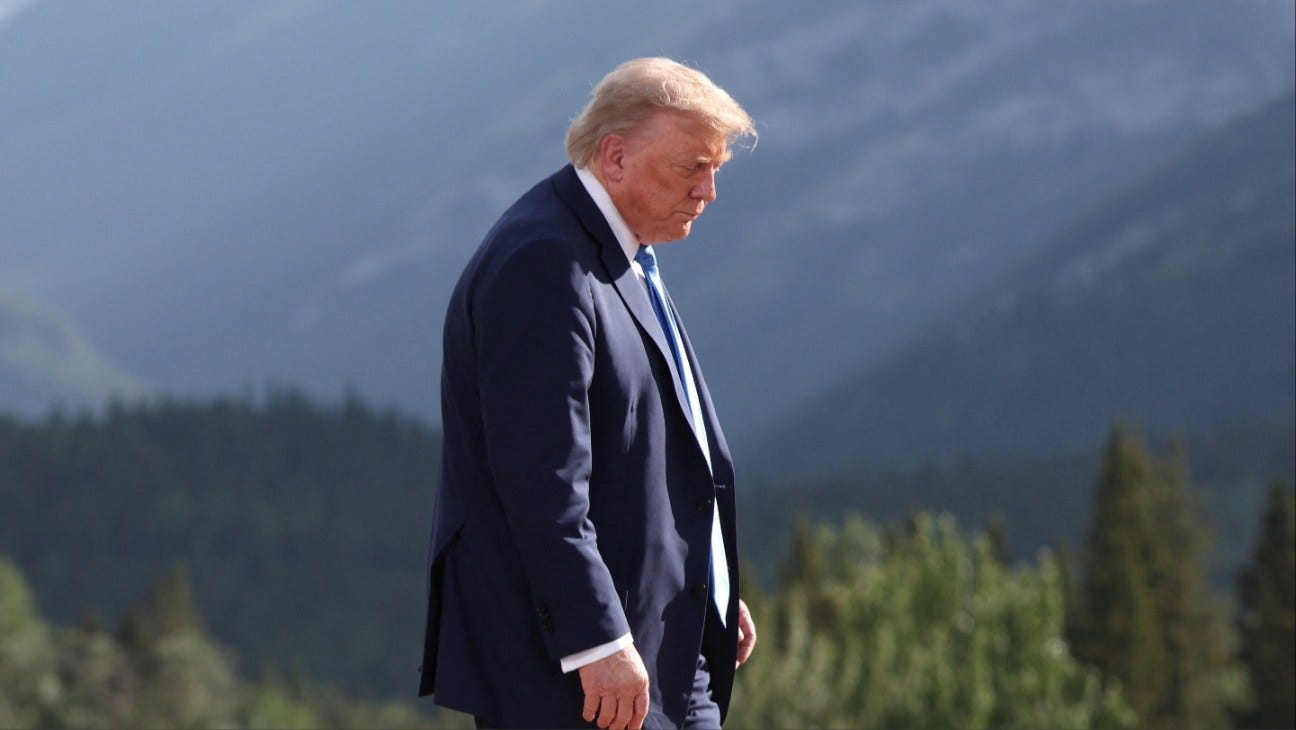
I don’t get the sense Republicans understand how much worse things could get for them.
The midterms were not a close call. Democrats won the House popular vote 56% to 42%, a 14-point margin and the largest for either party since the post-Watergate election of 1974. Bigger than 2006. Bigger than 2010. Bigger than 2018. Democrats have flipped 46 House seats and counting, and took the Senate on a map that ran through Texas, Kansas, and Mississippi.
A defeat of that magnitude would ordinarily force some serious reflection. Parties lose elections for all kinds of reasons, but when voters deliver a rejection this sweeping, the political incentives to change course are usually overwhelming.
Republicans appear to be drawing the opposite conclusion.
And there’s good reason to believe the consequences could extend well beyond this November. History suggests that unpopular presidents rarely recover ground in their final two years, particularly when the problems that drove their party’s defeat remain unresolved. Trump is entering that period with historically weak approval ratings, a party increasingly insulated from competitive elections, and little apparent interest in changing direction.
Losing parties usually look in the mirror
The post-defeat reckoning is one of the most reliable rituals in American politics. The diagnosis isn’t always right, but the instinct is close to universal:
Democrats after 1984. Walter Mondale lost 49 states. Within a year, a group of Democrats founded the Democratic Leadership Council to drag the party back toward the middle. That project produced Bill Clinton.
Clinton after 1994. After losing both chambers, Clinton reoriented his presidency. By 1996 he was declaring the era of big government over, and he won re-election comfortably.
Obama after 2010. Obama called it a “shellacking,” owned it, and cut a lame-duck tax deal with Republicans weeks later.
Republicans after 2012. The RNC commissioned the Growth & Opportunity Project, the famous “autopsy.” Its own focus groups described the party as “scary,” “narrow minded” and “out of touch.”
But the most relevant precedent is George W. Bush in 2006. Like this year, that midterm was a referendum on an unpopular war. Bush called it a “thumping.” And the very next day, he announced Donald Rumsfeld’s resignation — the architect and public face of the war voters had just rejected. Within weeks, the administration was rethinking its entire Iraq strategy.
That shift did not amount to an embrace of what antiwar voters wanted. In important respects, it represented the opposite. But Bush at least recognized that the political and strategic status quo had become untenable.
Trump’s answer: change nothing
Twenty years later, a Republican president lost Congress over an unpopular war. Here’s what he did the next day.
He insisted the GOP would have won in a “landslide” if he had been on the ballot, and blamed Republican candidates for failing to inspire voters. Asked about the war in Iran, he said he would have done nothing differently and would do it again. Asked whether he’d replace Pete Hegseth — the war’s loudest champion — he said Hegseth was “doing a very good job” and that he has “every intention” of keeping him.
Bush fired his defense secretary within 24 hours. Trump gave his a vote of confidence.
Then, less than a week after saying he’d accept the results, Trump revived claims the election was rigged by voting machines and early-vote “dumps.” There will be no autopsy. There will be no Rumsfeld moment.
Congressional Republicans have taken the hint. House Freedom Caucus leaders argued the party lost because it didn’t go far enough. Scott Perry, who lost his own battleground seat, put it simply: “Nobody listened to us.” Then the conference handed its leadership to Jim Jordan, a founding member of the Freedom Caucus, who beat Steve Scalise 106–73 for minority leader.
The Republican caucus is movign further right
Following their worst defeat in half a century, Republicans aren’t just doubling down. They’re tripling down — and the members who might have pushed back are gone.
Waves don’t hit both wings of a party equally. They wash out the members in competitive seats, and in the GOP those are disproportionately the remaining pragmatists. The centrist Republican Governance Group lost nearly half of its members, and the Problem Solvers Caucus lost 13 of its 19 Republicans, including its GOP co-chair.
The starkest measure is what happened to the Republicans who voted to certify the 2020 election. On January 6, 2021, 66 House Republicans voted against every objection to the electoral count. 41 of them were still in the House going into this cycle. Just 19 will be there in January. The 2026 cycle alone took out more than half of those who were left. In the Senate, only 22 of the 43 Republicans who voted to certify will be back.
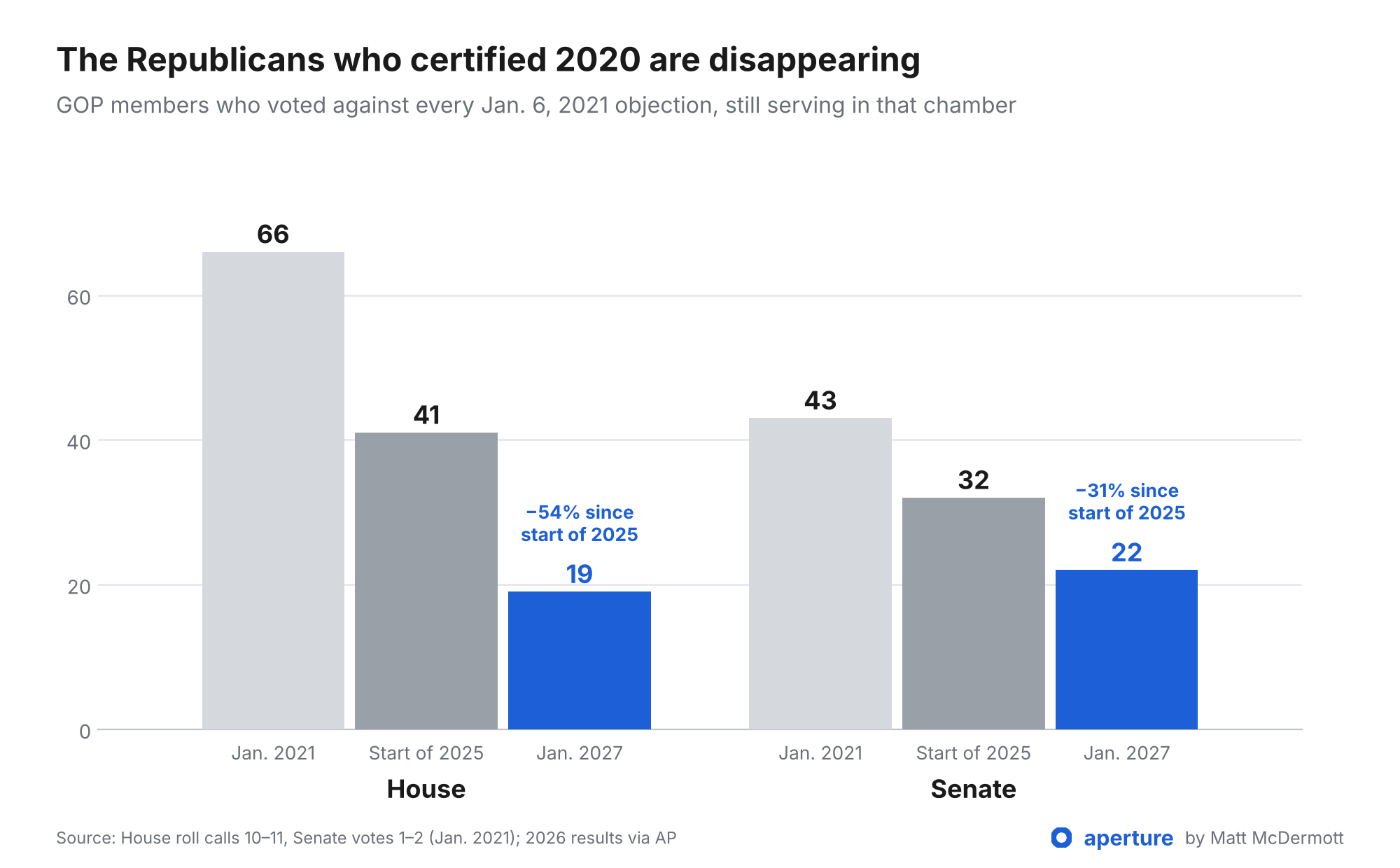
The primaries had already done their part: Thomas Massie, Dan Crenshaw, Bill Cassidy and John Cornyn were all ousted before November, most by Trump-backed challengers. Brian Mast summed it up: “we’re a significantly more conservative conference than what we were coming into this.”
The members left standing come overwhelmingly from safe, deep-red seats, where the only threat that matters is a primary. Their incentive is to fight harder, not to moderate. The members whose incentives pointed toward the middle were the ones voters just fired.
Lame ducks almost never recover
Here’s the thing about a president’s final midterm: it’s rarely the bottom.
Look at every president since Truman who faced voters in a final midterm and then handed off to a successor. From the midterm to the next presidential Election Day, 5 of 7 lost ground in Gallup’s approval rating, by an average of 9 points among those who fell. Reagan, Clinton and Bush each shed 9 to 13 points. Across all 7, the average change is −4.6.
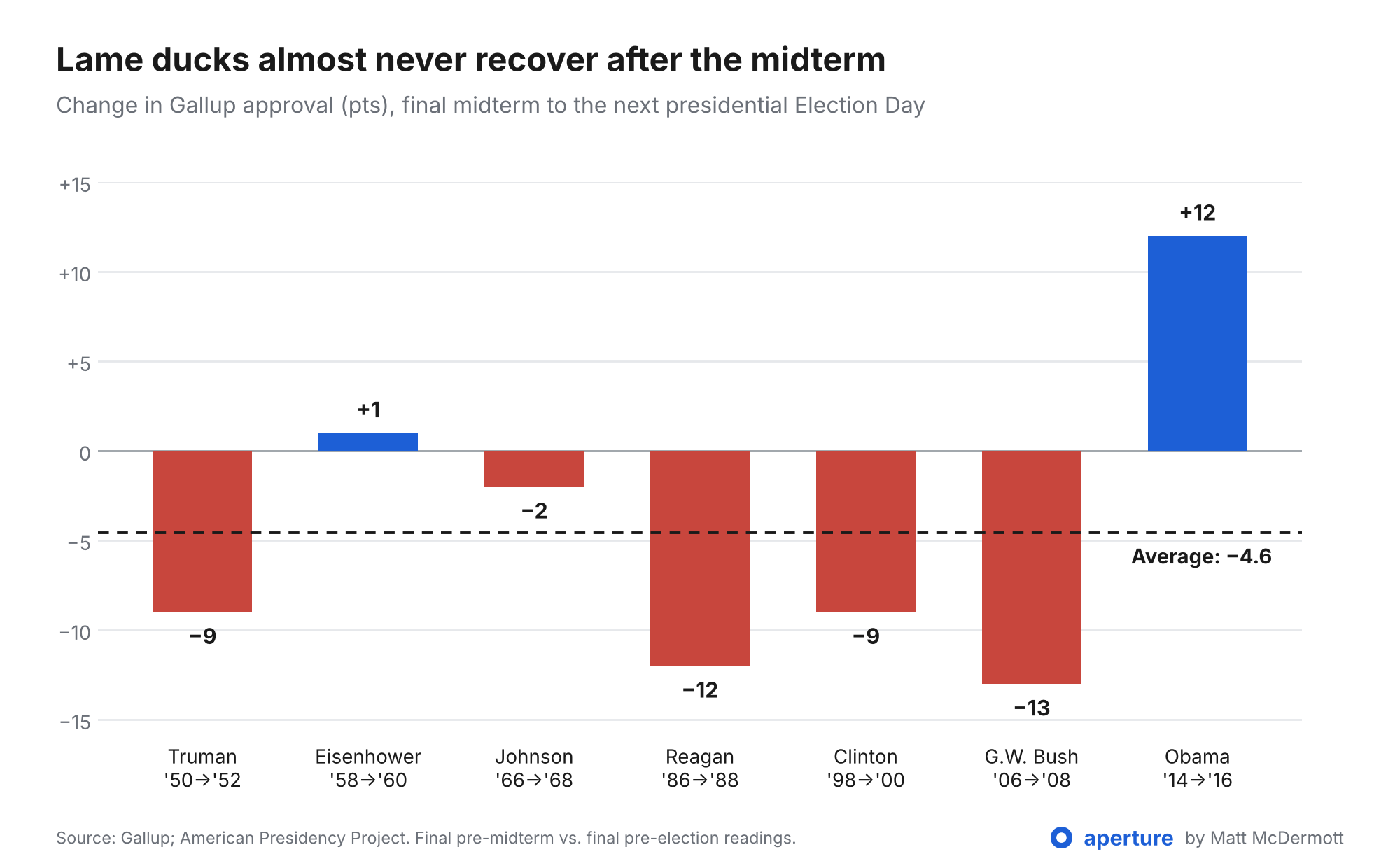
Only one president meaningfully climbed out: Barack Obama, who gained 12 points between 2014 and 2016. But Obama’s numbers had already stabilized after his midterm, the economy was steadily improving, and he spent 2015 and 2016 governing like a president who’d heard the message. Eisenhower technically ticked up a single point. Nobody else did.
That’s the default for a president who handles a midterm loss well. Trump isn’t handling it well.
Trump is starting exactly where Bush did
The comparison with George W. Bush isn’t limited to the political circumstances surrounding their respective midterm defeats. Their approval ratings were remarkably similar.
On the eve of the 2006 midterms, Gallup had Bush at 38% approval. On the eve of the 2026 midterms, the Silver Bulletin average had Trump at 38.4%. Same war-driven midterm. Same starting point.
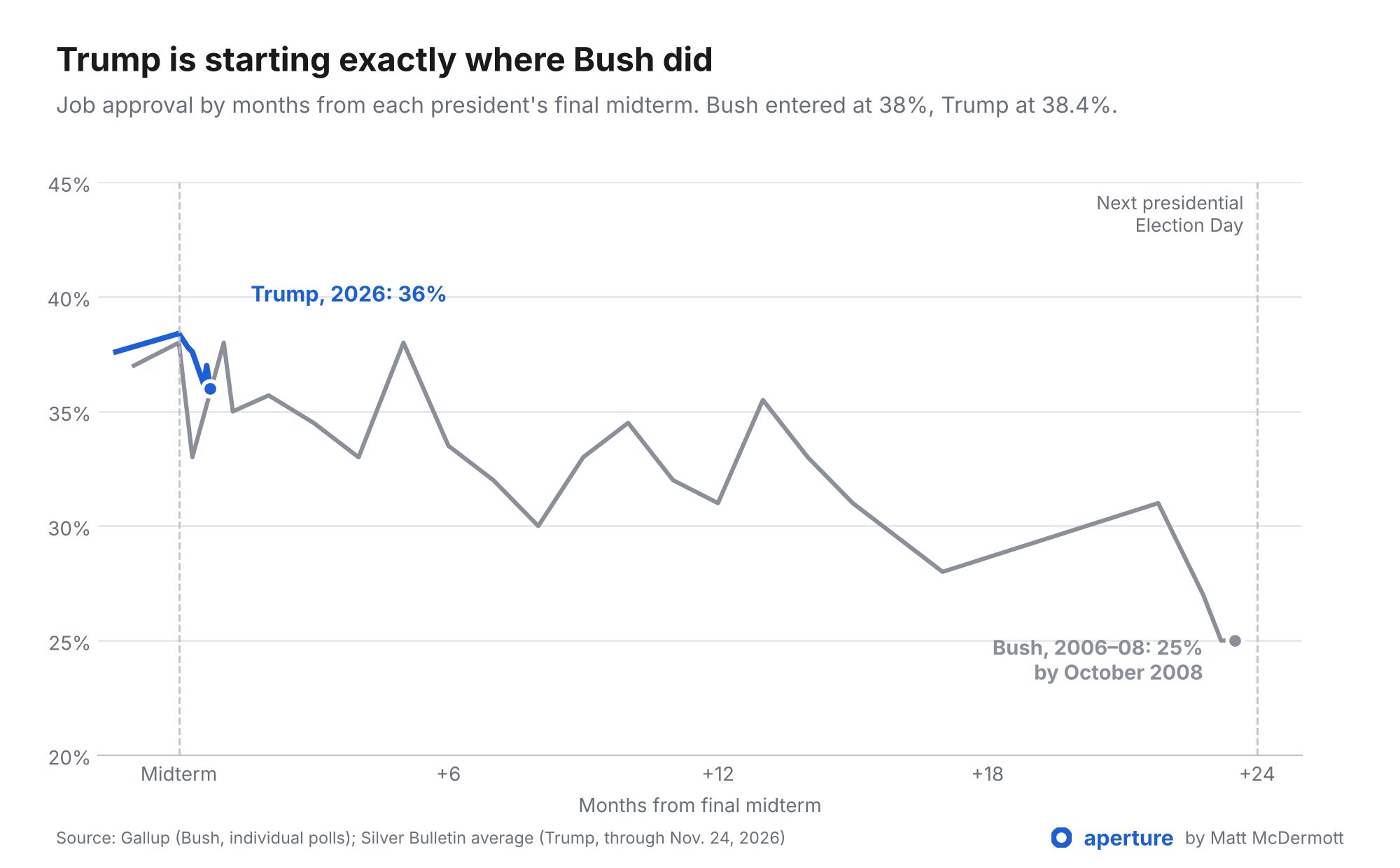
Bush’s numbers never came back. He dipped to 33% right after the election, spent 2007 bouncing between 29% and 38%, and bottomed out at 25% in October 2008. And that was a president who fired his defense secretary and changed course.
Trump, who has changed nothing, is still sliding. As of Nov. 24, the Silver Bulletin average has him at 36.0% approve, 60.7% disapprove, down from 38.4% on the eve of the election. That’s a new all-time low, below the 36.4% the polling averages recorded at his worst point in the first term. Individual polls are worse. Economist/YouGov had him at 32% approve, 63% disapprove Nov. 9–11, his worst in that series across either term, and Reuters/Ipsos had him at 32% a week later.
If Trump simply tracks Bush’s final 2 years from here, he’s in the mid-20s by the fall of 2028.
Can he really fall that far?
Maybe not all the way. The electorate is more polarized than it was in 2008, and Trump’s base has proven more durable than Bush’s. Bush’s last leg down also came with a once-in-a-generation financial crash.
But the low 30s don’t require a financial crash. They only require what we’re already watching: a costly war the president says he’d fight again, a defense secretary he won’t touch, a cost-of-living problem he’s blaming on bad messaging, a party that reads its defeat as a mandate to go harder, and election denialism that even Megyn Kelly answered with two words: “Just stop.” Some polls already have him there.
Why this matters for 2028
The 2026 midterms were a referendum on Trump. Republicans in 2028 won’t get to run without him. As one GOP strategist noted about John McCain in 2008, the nominee didn’t have to be Bush to lose because of Bush: “He was still of the same party, and that is ultimately what mattered to voters.”
Every party that’s come back from a wipeout started by admitting what went wrong. Bush, for all his flaws, at least tried. Trump won’t. It’s conceivable — if not likely — that a D+14 bloodbath wasn’t rock bottom for Republicans.
It may have been the opening act.