



Something Has Changed Inside the Democratic Party
For the first time in a long time, Democrats came together with something to celebrate.
But jubilation wasn’t the prevailing mood in Denver this week, where thousands of Democratic leaders, strategists, and activists gathered for What’s Next, a two-day conference hosted by Majority Democrats.
It was ambition.
Majority Democrats is a relatively new organization working to cultivate the party’s next generation of leaders, expand its electoral map, and build lasting governing majorities. The conference was originally conceived as a smaller gathering to digest the midterm results and chart a path forward.
Then came a historic midterm election.
Democrats delivered their strongest midterm performance in half a century, reclaimed both chambers of Congress, flipped Senate seats in Texas and Mississippi, and won across a political map that looked almost unrecognizable from two years earlier.
Almost overnight, a post-election debrief became something much bigger: a showcase for the party’s next generation, a platform for Democrats who won in traditionally Republican states, and an early proving ground for potential 2028 presidential contenders.
The question now is how Democrats turn an extraordinary election into something lasting. After spending the past few days in Denver, nine takeaways stand out.
1. Democrats have set their sights on a durable governing majority.
Perhaps the most striking thing about Denver is how quickly the conversation moved beyond 2026. Democrats aren’t simply thinking about protecting their gains in 2028. They’re thinking about building a durable governing majority capable of reshaping American politics for years to come.
And yes, they’re seriously talking about a 60-seat Senate supermajority.
That ambition extends to an electoral map that puts states like Iowa, Missouri, and Utah in play. Pennsylvania Governor Josh Shapiro went even further, challenging Democrats to think beyond the 270 electoral votes needed to win the presidency and imagine a coalition capable of winning 370.
For much of the past two decades, Democratic strategy has revolved around a shrinking collection of battleground states, with entire regions effectively written off. The results of 2026 challenge those assumptions. Democrats won in states and communities that have spent years moving away from the party, forcing a reconsideration of where Democrats can compete.
One extraordinary election doesn’t establish a permanent political realignment. But the ambition has changed. Democrats aren’t simply asking how to assemble the narrowest possible coalition to win the next election. They’re asking how to build a majority large enough to govern, sustain public support, and compete across a much broader political map.
2. The Democratic Party’s ideological civil war is an online phenomenon.
One of the most revealing moments in Denver came when the same audience that enthusiastically applauded Senator Chris Van Hollen gave Pennsylvania Governor Josh Shapiro a standing ovation.
The contrast with Democratic discourse online is striking. Social media is consumed by ideological litmus tests and factional fights over the party’s future. But in Denver, the audience enthusiastically embraced politicians representing very different visions of the Democratic Party. The appetite for ideological purity is considerably weaker than the appetite for leaders willing to fight for what they believe.
Michigan Senator Elissa Slotkin made the broader point explicitly, rejecting the notion that the party’s future should be defined by whether Democrats need to be more progressive or more moderate.
The disagreements aren’t imaginary. Protesters gathered outside the conference, hecklers interrupted Hakeem Jeffries, and speakers expressed real policy differences. Nor is this audience a perfect representation of the Democratic coalition.
But the disconnect between the factional warfare online and the enthusiasm inside the room is hard to ignore. Social media rewards ideological conflict and increasingly narrow definitions of who belongs in the party. In Denver, people seemed far more interested in what politicians could accomplish than which faction could claim them.
3. A lot of Republicans simply didn’t show up in 2026.
An important finding discussed in Denver concerned what actually happened in the 2026 electorate. Democrats didn’t achieve their historic victory primarily by converting enormous numbers of Trump voters. A substantial part of the story is that those voters simply didn’t show up.
The numbers are striking. In Texas, the Democratic nominee for governor received 8% more votes than Kamala Harris did in 2024, while the Republican nominee received 30% fewer votes than Donald Trump. The same pattern holds in Florida and Ohio, where Democratic nominees retained 86% and 95% of Harris’s vote, respectively, compared with just 68% and 64% of Trump’s vote for their Republican opponents.
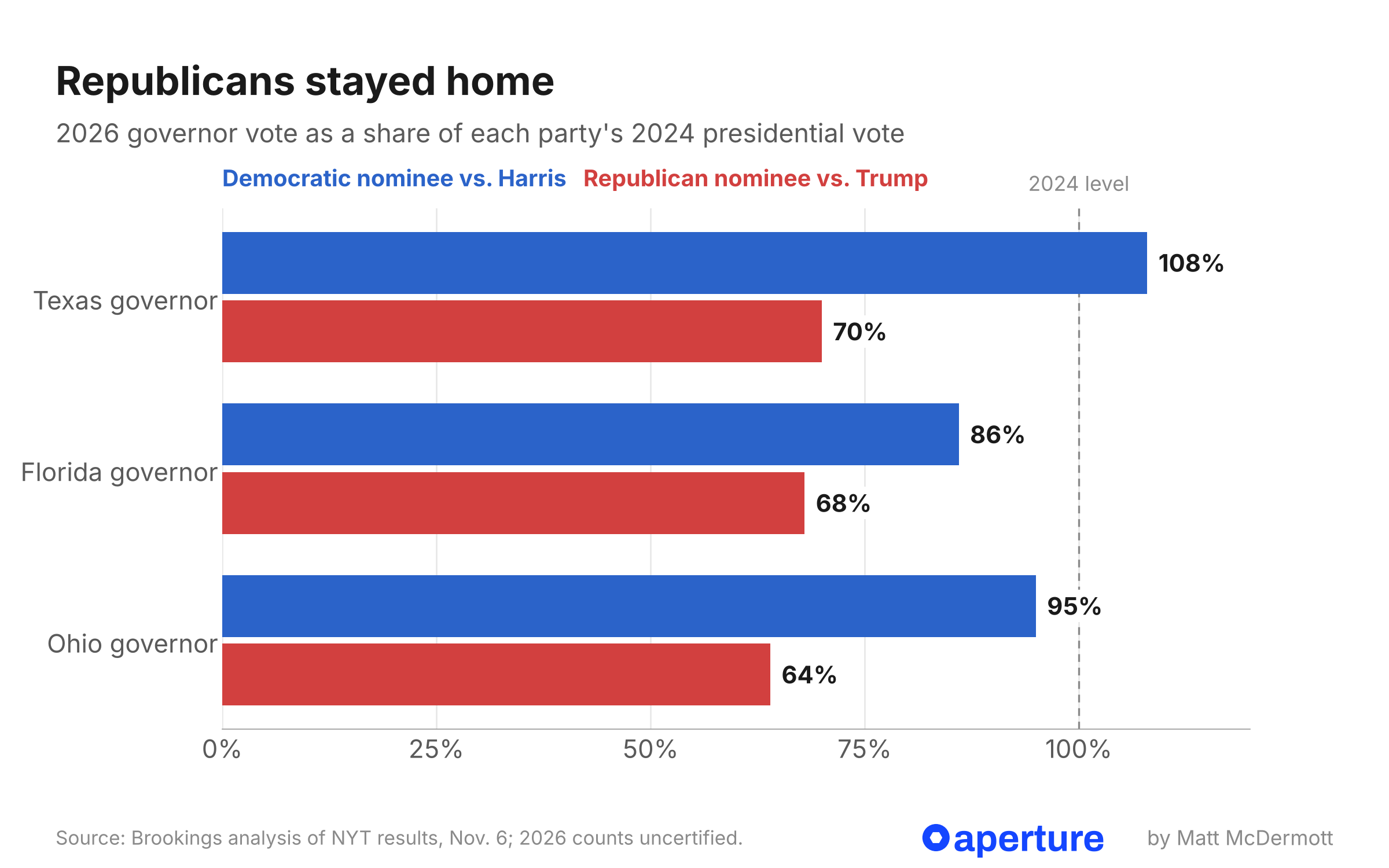
Individual-level voting data reinforces the pattern. In Georgia and Texas counties examined, 56% of Harris voters participated in 2026, compared with just 47% of Trump voters. One early analysis of 13 states attributes roughly 75% of Democrats’ gains to differences in turnout and approximately 20% to voters switching sides.
Democrats have every reason to celebrate the scale of their victory. But most of the voters they lost in 2024 haven’t necessarily become Democrats again. And voters who stayed home for a midterm election can return in a presidential year.
The turnout story is central to understanding both the magnitude of Democrats’ 2026 victory and the limits of what it tells us about 2028.
4. Every issue is an affordability issue now.
If there is one theme that ran through nearly every conversation in Denver, it’s affordability. Across speeches, policy discussions, and debates about the party’s future, cost of living is the defining political issue of the moment.
But affordability is not simply one issue competing for voters’ attention. It’s increasingly the lens through which voters evaluate everything else.
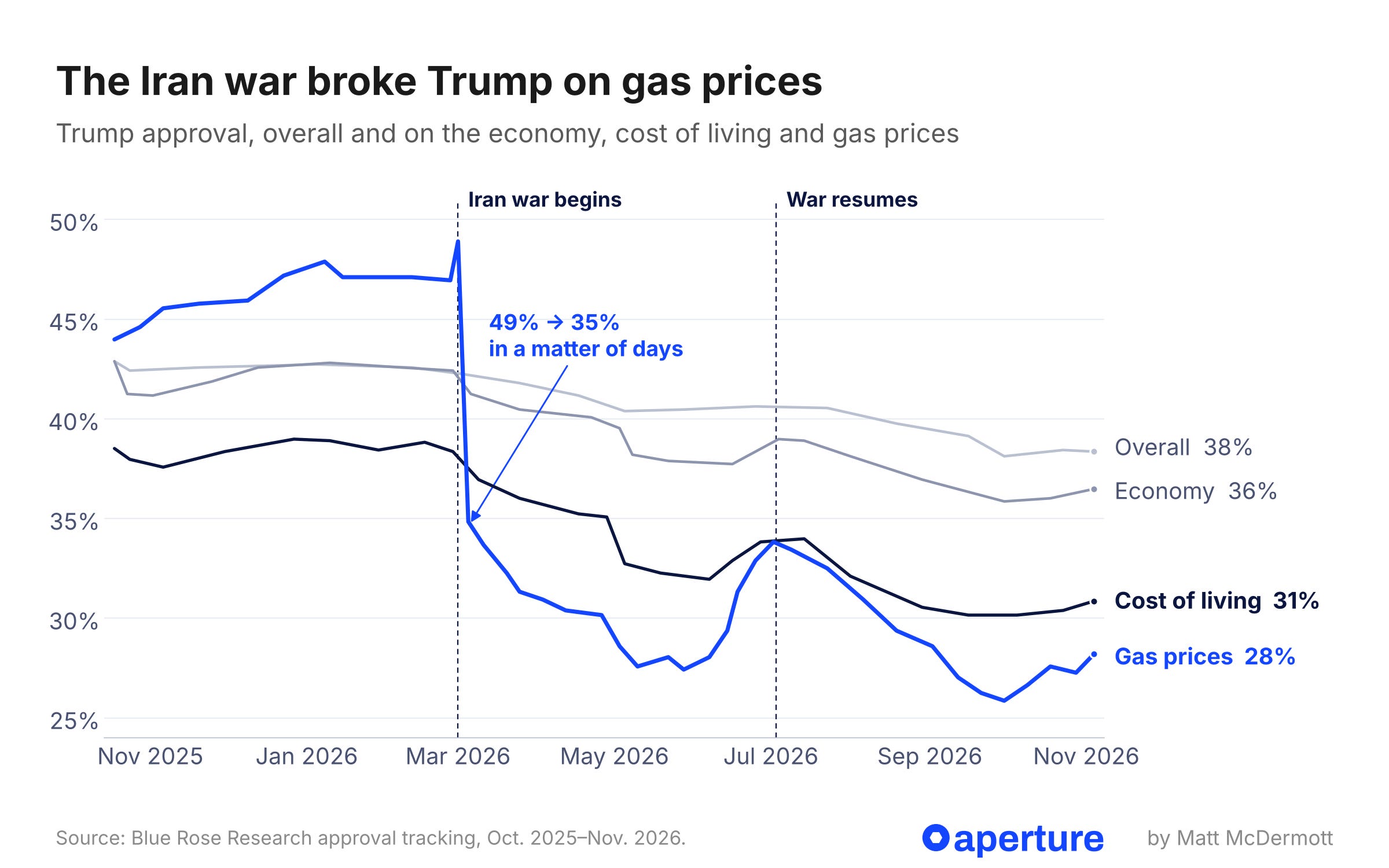
Consider the war in Iran. Foreign policy is traditionally debated through questions of national security, military strategy, and America’s role in the world. But for millions of Americans, the war shows up first at the gas pump.
In tracking by Blue Rose Research, Trump’s approval on gas prices stood at 49% when the war began. Within days, it collapsed to the mid-30s. It hasn’t recovered and now stands at just 28%. His approval on the broader cost of living follows a similar trajectory.
The same dynamic extends across the issue agenda. Health care is an affordability issue because premiums, deductibles, and prescription drugs determine how much money families have left over. Housing determines whether people can save, start families, or build financial security. Even immigration debates become affordability debates through competing claims about wages, housing, and labor markets.
Tariffs, energy policy, education, infrastructure. Nearly every major political debate eventually returns to the same question: What does this mean for my cost of living?
This is about more than telling Democrats to talk about the economy. Voters don’t experience public policy in separate categories. They experience its consequences together, in the same household budget. And increasingly, that budget is how they judge nearly every political decision.
5. Across the ideological spectrum, Democrats agree on one thing: Government has to deliver.
For all the ideological differences within the Democratic Party, a striking consensus emerged in Denver: with Democrats taking the majority in Congress, government has to work to make people’s lives materially better.
Progressive and moderate voices alike emphasized confronting concentrated economic power and expanding access to essential services. Both focused on effective institutions, economic opportunity, and restoring confidence in government’s ability to solve problems. The prescriptions differ on the margins, but the underlying objective is remarkably consistent.
The conversation in Denver repeatedly returns to a more fundamental question: Can government actually deliver results?
That question transcends traditional ideological divisions. Voters have grown skeptical that political promises will translate into meaningful improvements in their lives, regardless of which party is making them.
Americans have lost faith that government can actually deliver things that materially benefit their lives.
For Democrats, that creates both common ground and a demanding standard of accountability. The argument that government can improve people’s lives only works if voters can see the evidence.
6. The populism of 2026 is fundamentally different from the populism of 2016.
Ten years ago, economic populism was already reshaping American politics. Bernie Sanders built a national movement around concentrated wealth and corporate power. Donald Trump presented himself as an opponent of political and economic elites. Both tapped into frustration with institutions that many Americans believed no longer worked for them.
But the populism of 2026 is different in one fundamental respect: The political influence of extraordinary wealth has become far more visible, personal, and immediate.
In 2016, much of the argument concerned relatively abstract institutions: Wall Street, corporate America, special interests, and the donor class. Today, those arguments have recognizable faces.
Elon Musk is the clearest example. He’s not simply another wealthy donor operating behind the scenes. His business interests, public statements, and political interventions make the relationship between concentrated wealth and political power far more visible.
And the stakes extend beyond campaign contributions. Questions about who controls technology platforms, who shapes artificial intelligence, who benefits from government contracts, and who can spend extraordinary sums influencing elections are increasingly part of everyday political discourse.
The populism of 2016 was largely about identifying a system that voters believed was rigged. In 2026, that argument has become considerably more concrete. Voters can see the people wielding extraordinary influence, the decisions they’re making, and the consequences of those decisions.
7. Money still matters. But its political impact may be changing.
Political spending has always mattered. It allows campaigns and outside groups to reach more voters, more frequently, across more platforms. But the growing visibility of billionaire political spending introduces an interesting complication.
Consider Texas. James Talarico spent his campaign arguing that billionaires were attempting to buy political influence. Then Elon Musk’s super PAC intervened in the race against him.
The identity of the spender mattered. Musk’s intervention generated news coverage, attracted scrutiny, and reinforced the very argument Talarico had been making.
The spending itself became part of the political story.
Under certain conditions, the visibility of extraordinary political spending may actually diminish its persuasive effectiveness. When voters are already concerned about billionaire influence, a highly visible billionaire intervening in an election can become evidence supporting the opposing candidate’s argument.
None of this means money has stopped mattering. Spending still funds turnout operations, builds campaign infrastructure, and saturates media markets.
But Texas raises a question worth examining more systematically. What happens when the identity of the spender becomes as politically consequential as the advertising itself? In an environment where billionaire influence is increasingly visible and contested, the effects of political spending may be considerably less predictable.
8. The next big Democratic ideas might be surprisingly small, but hugely tangible.
One of my favorite moments in Denver came from North Carolina Attorney General Jeff Jackson, who offered a surprisingly practical vision of what Congress could do to make everyday life better: Go after scams and ban robocalls.
It’s a deceptively powerful example. Americans reported losing a record $15.9 billion to fraud in 2025, according to the Federal Trade Commission. Millions experience these problems directly, from relentless robocalls to sophisticated scams that can wipe out a family’s savings.
Imagine a government that actually reduced fraudulent calls or made it meaningfully harder for scammers to steal money from seniors. Those achievements might never dominate a presidential campaign, but people would notice.
Political professionals tend to measure policy ambition by the scale of a proposal.
But voters often experience government through much smaller interactions: A medical bill that becomes manageable. A permit that no longer takes six months. A prescription that costs less. A bureaucratic process that finally works.
The political significance of those achievements may be amplified precisely because voters can experience the results without needing anyone to explain them.
The lesson isn’t to abandon ambitious reforms. It’s that the scale of a policy’s political impact isn’t always proportional to the size of the legislation. The next generation of Democratic ideas may be defined as much by what people can feel as by what politicians can promise.
9. AI is an existential challenge, and political leaders are running out of time to confront it.
One of the most arresting moments in Denver came from journalist Jerusalem Demsas, who delivered a chilling warning about the dangers of artificial intelligence: “Terrorism by morons is coming.”
Her argument is that AI threatens to dramatically lower the barriers to catastrophic violence, potentially giving individuals access to dangerous capabilities that once required considerable technical expertise. AI-assisted terrorist attacks may already have occurred, she warned. And the technology is advancing faster than governments are preparing to manage its risks.
Demsas drew a sobering parallel to the pandemic. Millions died from COVID-19, yet governments have still failed to implement many of the preparedness measures that could prevent another catastrophe. Her warning was simple: Don’t wait for a Hiroshima- or Nagasaki-scale event before taking AI safety seriously.
It’s a striking reminder that the political debate over AI cannot be confined to jobs, data centers, energy costs, or the concentration of wealth. Those are consequential issues. But the possibility that AI could enable catastrophic harm raises a more fundamental question about government’s responsibility to anticipate threats before they become crises.
The challenge for Democrats is not simply to develop a position on AI. It’s to recognize that the decisions being made now could determine whether government is prepared for dangers that are rapidly becoming more plausible.
The bigger picture
Democrats leave Denver with ambitions that would have seemed almost unimaginable a year ago. But a historic electoral victory is not the same thing as a durable governing majority. Building one requires more than winning elections. It requires giving voters a reason to keep voting Democratic.
One of the clearest warnings in Denver is that Democrats may have just 12 to 18 months to demonstrate what they stand for before the political pendulum swings back. The party is on probation with voters who may not particularly like Democrats, but have given them another chance.
Democrats have won an extraordinary amount of political power. Whether 2026 marks a temporary rejection of Republican governance or the beginning of something more lasting depends on what they do with it.
For the first time in a long time, Democrats aren’t just asking how to win the next election. They’re asking what it will take to build a majority that lasts.