


There are elections that change who holds power in Washington. And then there are elections that fundamentally change the political landscape of the country.
November 2, 2010, was one of those elections.
Most people remember the Tea Party wave for the 63 House seats Republicans picked up, ending Democrats’ congressional majority and effectively bringing Barack Obama’s legislative agenda to a halt.
But the most consequential Republican victories that night weren’t in Washington. They were in state capitols across the country.
Republicans gained roughly 680 state legislative seats, flipped 20 legislative chambers, and dramatically expanded their control of state governments. They didn’t just win an election. They captured the institutions that would shape American politics for the next decade and a half.
And the timing was no accident.
With the 2010 census complete and congressional redistricting approaching, Republicans were positioned to redraw the political map. Their new majorities helped determine which congressional districts would be competitive, which communities would be represented, and which candidates would have a realistic opportunity to win.
The consequences were immediate. In 2012, Democratic House candidates received approximately 1.4 million more votes nationwide than Republicans. Yet Republicans retained a comfortable 234–201 majority.
But the damage extended well beyond congressional maps.
By the end of Obama’s presidency, Democrats had lost nearly 1,000 state legislative seats. The party that entered the White House in 2009 with commanding congressional majorities found itself increasingly locked out of power across much of the country.
Republicans didn’t simply win in 2010. They spent the next 16 years compounding those victories into an extraordinary advantage across the institutions of American government.
Last Tuesday, Democrats began dismantling that political order.
Yes, Democrats won back Congress. But the bigger story is what happened outside Washington.
Democrats captured governorships in states that hadn’t elected one in decades. They flipped legislative chambers that had appeared permanently Republican. They expanded their control of state governments to levels not seen in a generation.
And they began rebuilding the political bench that Republicans spent 16 years decimating.
2026 may prove to be for Democrats what 2010 was for Republicans.
Not because the results were identical. They weren’t. And not because one election guarantees a generation of political dominance. It doesn’t.
But because Democrats won something potentially more consequential than a congressional majority: the institutional power to shape what comes next.
Here are five reasons why.
1. Democrats now govern most of America.
Start with the governors.
Democrats entered Tuesday holding 24 of the nation’s 50 governorships. They’re now on track to hold 30, their first majority since 2010.
And look at where they won.
In Texas, Gina Hinojosa became the first Democrat elected governor since Ann Richards in 1990. In Georgia, Keisha Lance Bottoms ended 24 years of Republican control. Democrats also flipped Ohio, Iowa, Nevada, and Alaska, while holding Kansas.
Republicans didn’t flip a single Democratic governorship.
But counting states tells only part of the story. California and Wyoming each get one governor, despite representing vastly different populations.
Before Tuesday, 60% of Americans lived in states with Democratic governors. That figure is now projected to reach 75%.
Three out of every four Americans.
And approximately 53% will live in states where Democrats control the governorship and both legislative chambers.
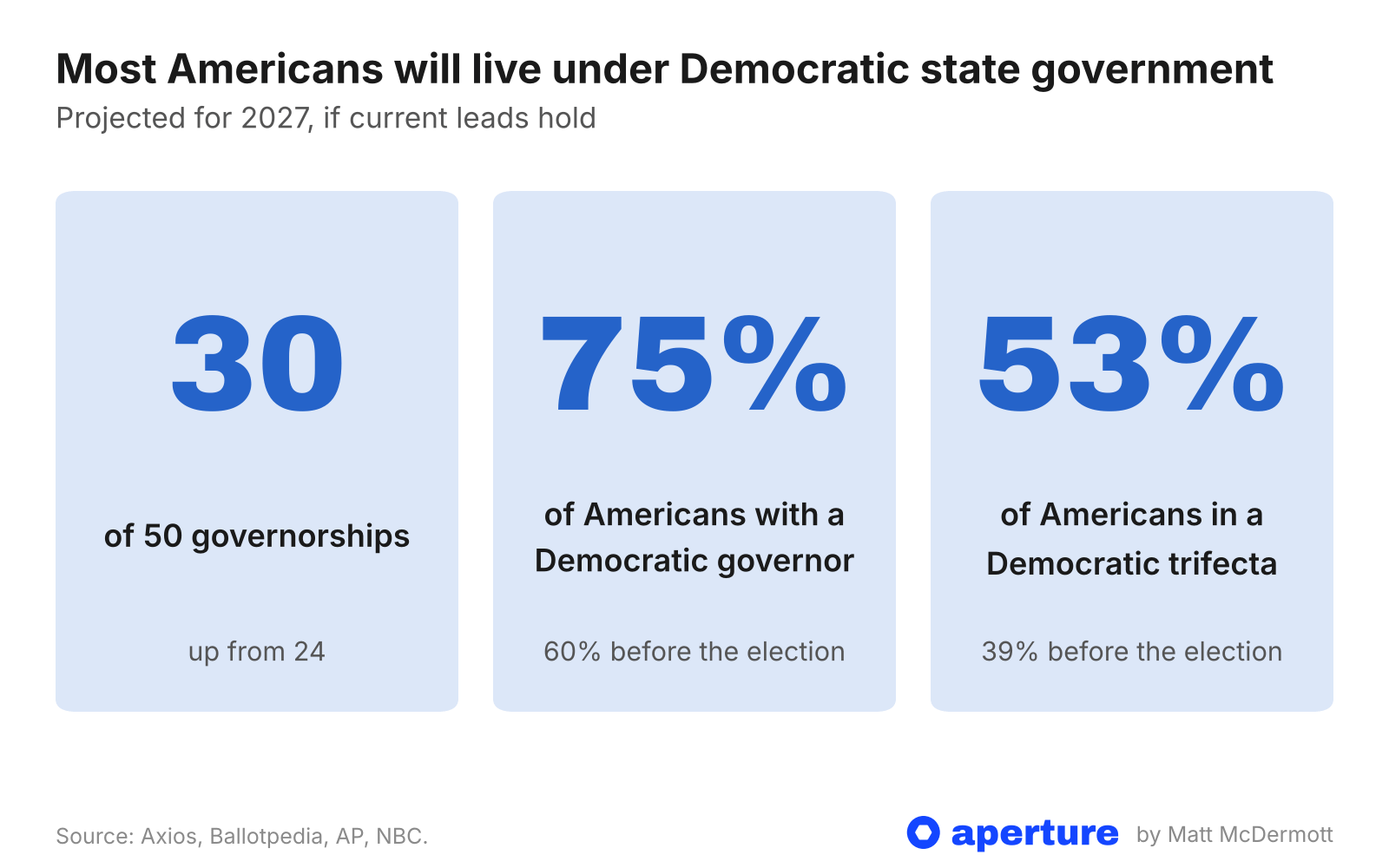
The geographic implications are just as striking. Democrats will hold the governorship in all seven of the states that defined the 2024 presidential battleground: Arizona, Georgia, Michigan, Nevada, North Carolina, Pennsylvania, and Wisconsin.
Every single one.
Now, a Democratic governor doesn’t necessarily mean a Democratic state government. In Texas, Hinojosa will govern alongside a Republican-controlled state Senate.
But that brings us to the next part of the story.
2. Democrats have broken Republicans’ 16-year grip on state legislatures.
This may be the most underappreciated result of the election.
Before the 2010 wave, Democrats controlled 60 of the country’s 99 partisan state legislative chambers.
Afterward, they controlled just 40. By 2015, that number had fallen to 30.
Republicans maintained their advantage for the next decade and a half.
Until Tuesday.
Democrats entered the election controlling 39 chambers. They’re now on track to control 51, compared with 46 for Republicans.
For the first time since 2010, Democrats are positioned to control a majority of America’s state legislative chambers.
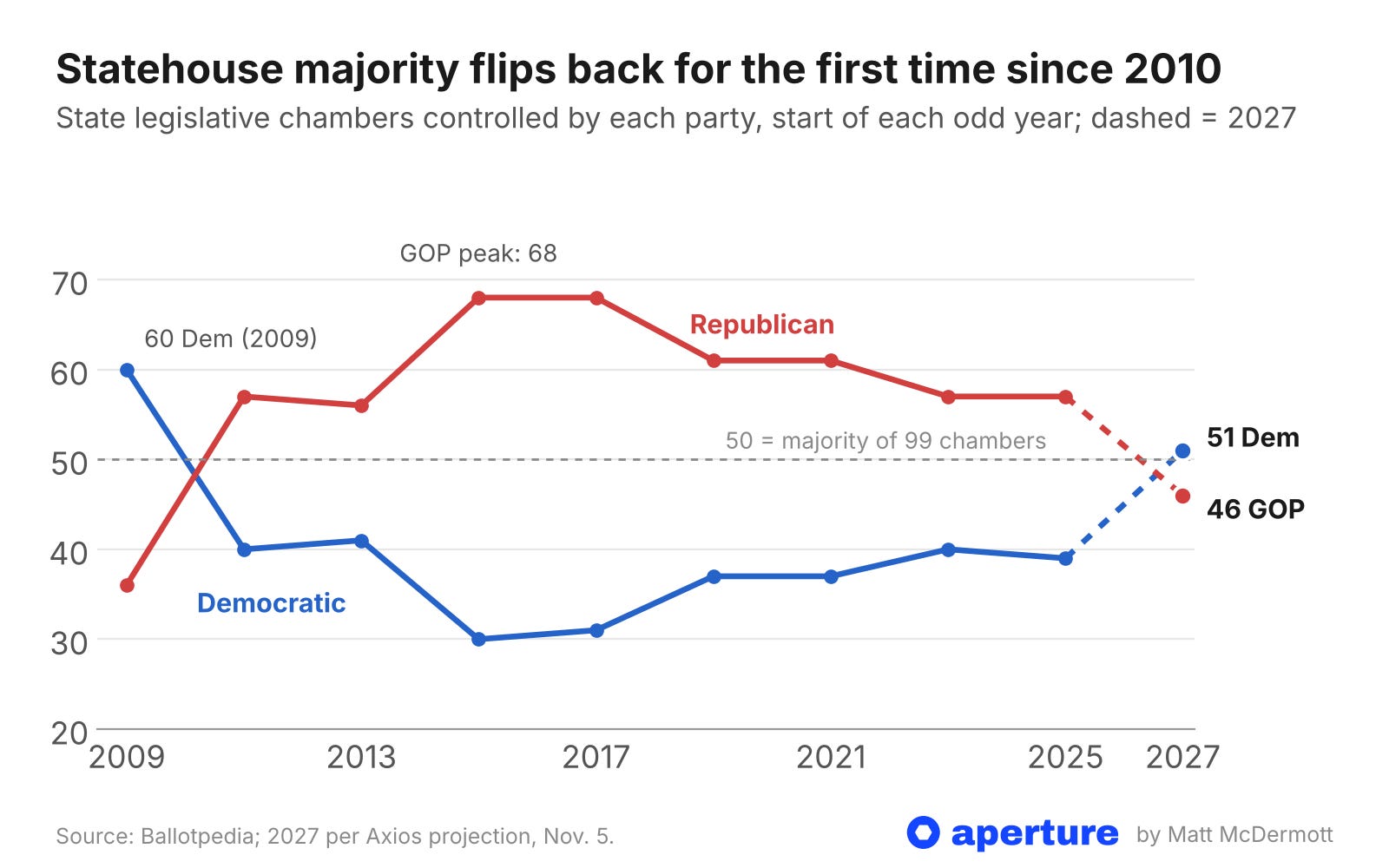
Democrats flipped 12 chambers in a single election. For context, just three changed partisan control in 2024.
And these weren’t simply competitive chambers changing hands.
In Arizona, Democrats won both legislative chambers for the first time since 1966. In Pennsylvania, they broke a Republican Senate majority dating to the 1990s. In Georgia and Texas, they captured state Houses that Republicans had controlled for more than two decades.
And in Wisconsin, Democrats reclaimed both legislative chambers that Republicans captured during the 2010 wave.
The historical symmetry is remarkable.
Altogether, eight chambers across six states are now poised to have Democratic majorities after at least 16 years in the minority.
Even where Democrats didn’t win outright control, they broke Republican supermajorities in 12 chambers, including in Missouri, Ohio, Indiana, Kansas, and South Carolina.
That’s important because a Republican supermajority can override a Democratic governor’s veto. Break that supermajority, and suddenly the governor’s signature matters again.
This is what it looks like when the institutional advantages of 2010 begin to unravel.
3. Democrats now control more state governments outright than at any point in decades.
If there’s one chart that captures the entire argument of this piece, it’s this one.
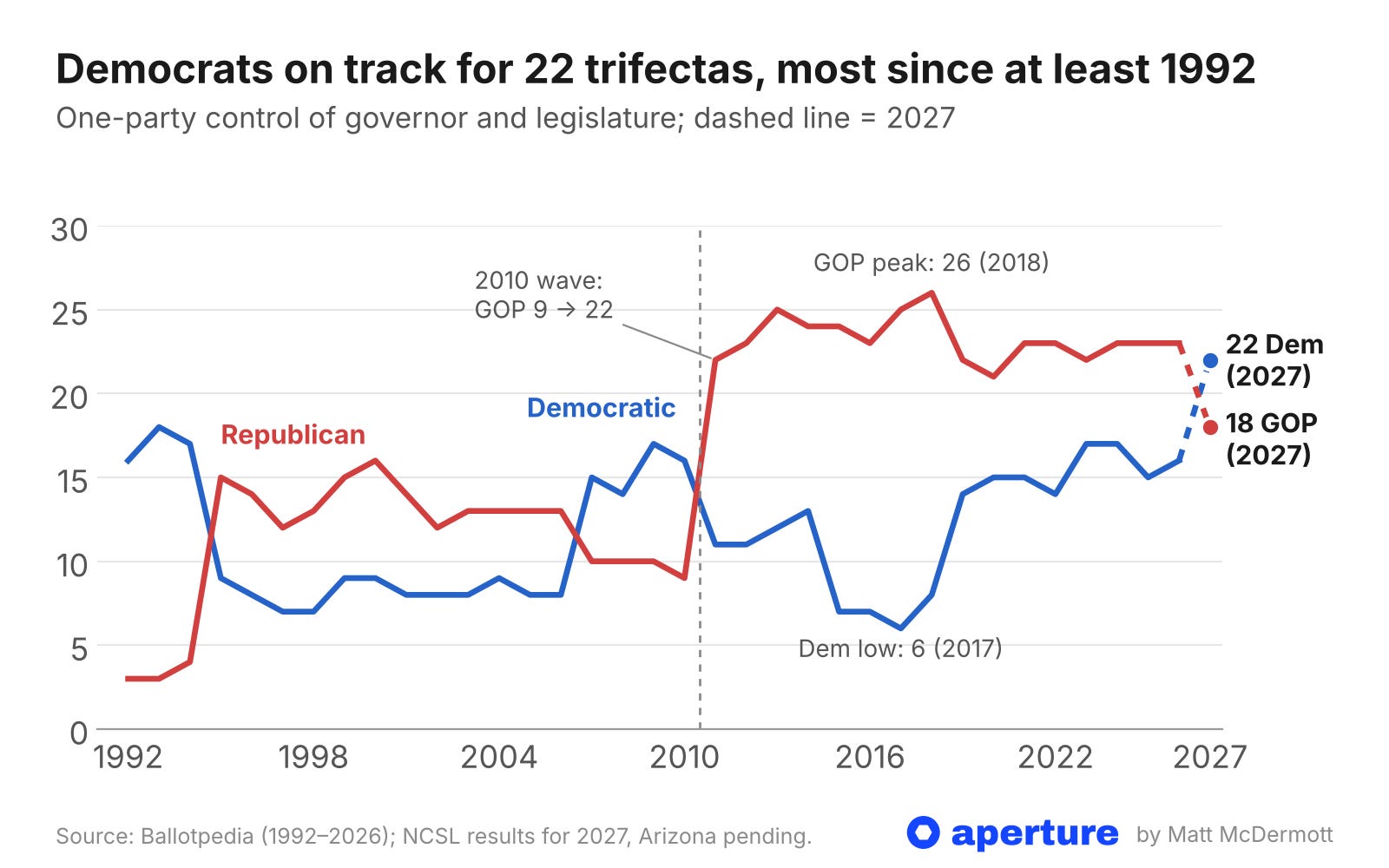
A state government trifecta occurs when one party controls the governorship and both legislative chambers.
It’s the difference between winning offices and controlling the institutions necessary to govern.
And it’s precisely what Republicans captured in 2010.
Before that election, Republicans controlled just nine state government trifectas. Afterward, they controlled 22. By 2018, that number had climbed to 26.
Democrats, meanwhile, bottomed out at just six in 2017.
Now look at Tuesday.
Democrats are on track to control 22 state government trifectas, their highest total since at least 1992. Republicans are projected to control 18.
For the first time since 2010, Democrats will control more state governments outright than Republicans.
Democrats gained unified control in Arizona, Michigan, Minnesota, Nevada, Pennsylvania, and Wisconsin.
Meanwhile, Republicans lost unified control in Georgia, Iowa, New Hampshire, Ohio, and Texas.
That second group is just as important.
Democrats don’t suddenly control Texas or Ohio because they elected Democratic governors. But Republicans no longer control those states without opposition.
And that changes what can become law.
Measured by population, the shift is even more striking.
Before Tuesday, 39% of Americans lived under Democratic trifectas. Now that figure is projected to reach 53%.
The share living under Republican trifectas is projected to fall from 42% to 24%.
For the first time in years, more Americans will live in states where Democrats can enact their governing agenda without Republican legislative approval than in states where Republicans can do the same.
That’s a fundamental change in the distribution of political power.
4. Democrats now hold critical election safeguards across the presidential battlegrounds.
There’s another consequence of Tuesday’s election that deserves considerably more attention.
The offices responsible for administering elections, certifying results, and defending election laws have shifted substantially toward Democrats.
And after everything this country experienced following the 2020 presidential election, that matters.
Consider the seven states that determined the 2024 presidential battleground.
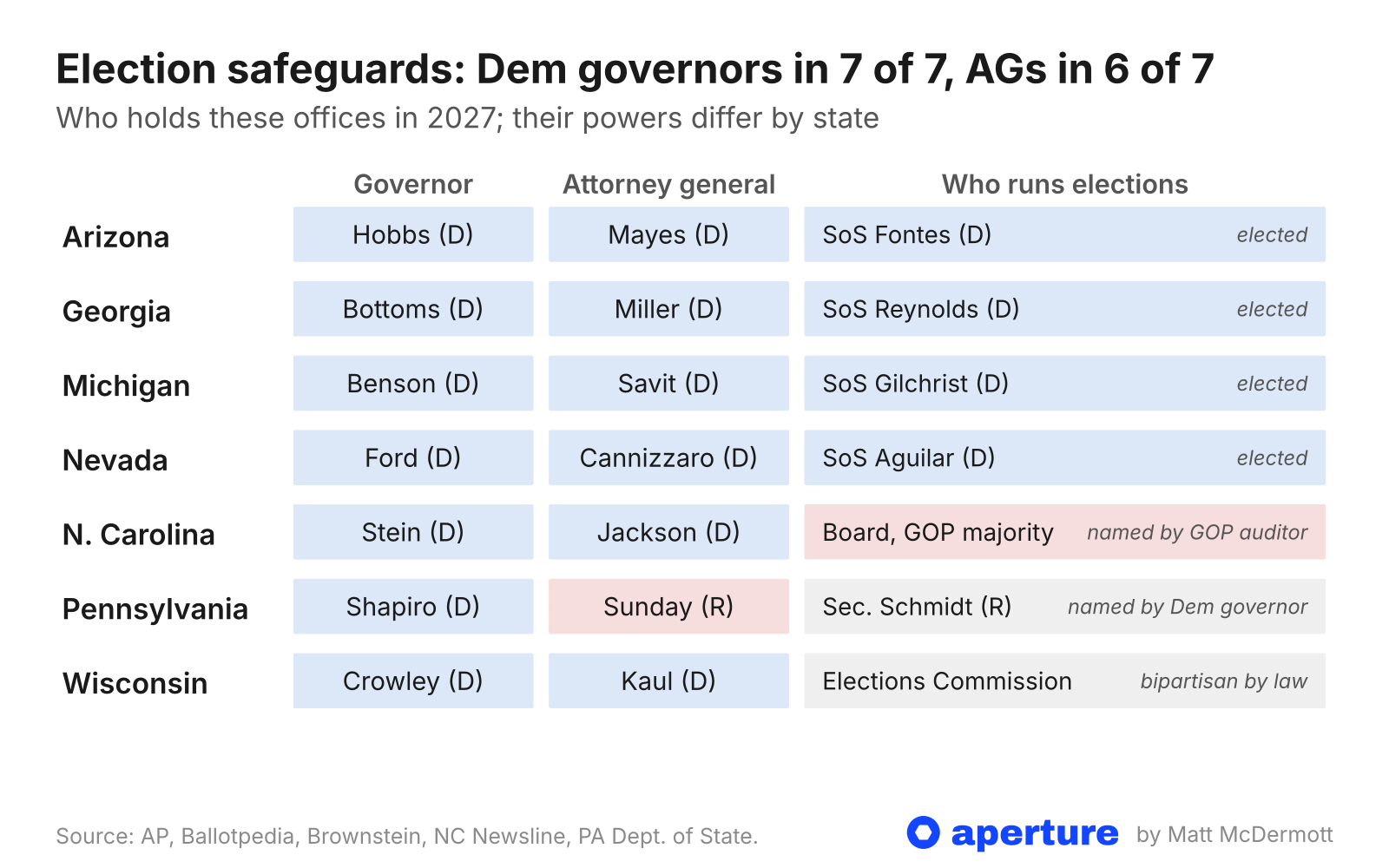
Democrats will hold the governorship in all seven.
They’ll hold the attorney general’s office in six.
And in all four battleground states where voters directly elect the secretary of state responsible for overseeing elections, Democrats will hold that office.
Arizona. Georgia. Michigan. Nevada.
Georgia offers perhaps the most striking example.
In 2020, Donald Trump pressured Georgia Secretary of State Brad Raffensperger to find enough votes to overturn his defeat.
Six years later, Democrats have won Georgia’s governorship, attorney general’s office, and secretary of state in the same election.
Now, election officials aren’t supposed to deliver partisan outcomes. Their responsibility is to administer elections fairly and according to the law.
And the powers of these offices differ considerably from state to state.
North Carolina’s elections board remains under Republican control. Pennsylvania has a Republican attorney general and a Republican secretary of the commonwealth appointed by Democratic Governor Josh Shapiro. Wisconsin administers elections through a bipartisan commission.
So the argument isn’t that Democrats control every election institution in every battleground.
They don’t.
But the broader shift is unmistakable.
Democrats now hold a substantially larger share of the offices responsible for administering elections and defending election laws in the states that will be central to the next presidential election.
And the courts have shifted as well.
Liberal justices hold a 5–2 majority on Wisconsin’s Supreme Court. Pennsylvania voters retained three Democratic justices in 2025, preserving a 5–2 Democratic majority.
The officials elected Tuesday will help oversee the 2028 presidential election.
That’s a consequence of 2026 that could matter long after this year’s results are forgotten.
5. Democrats just rebuilt the political bench Republicans spent 16 years destroying.
This is the part of the 2010 story that I think gets overlooked most often.
When Democrats lost nearly a thousand state legislative seats during the Obama years, they didn’t simply lose votes in state capitols.
They lost an entire generation of potential political leaders.
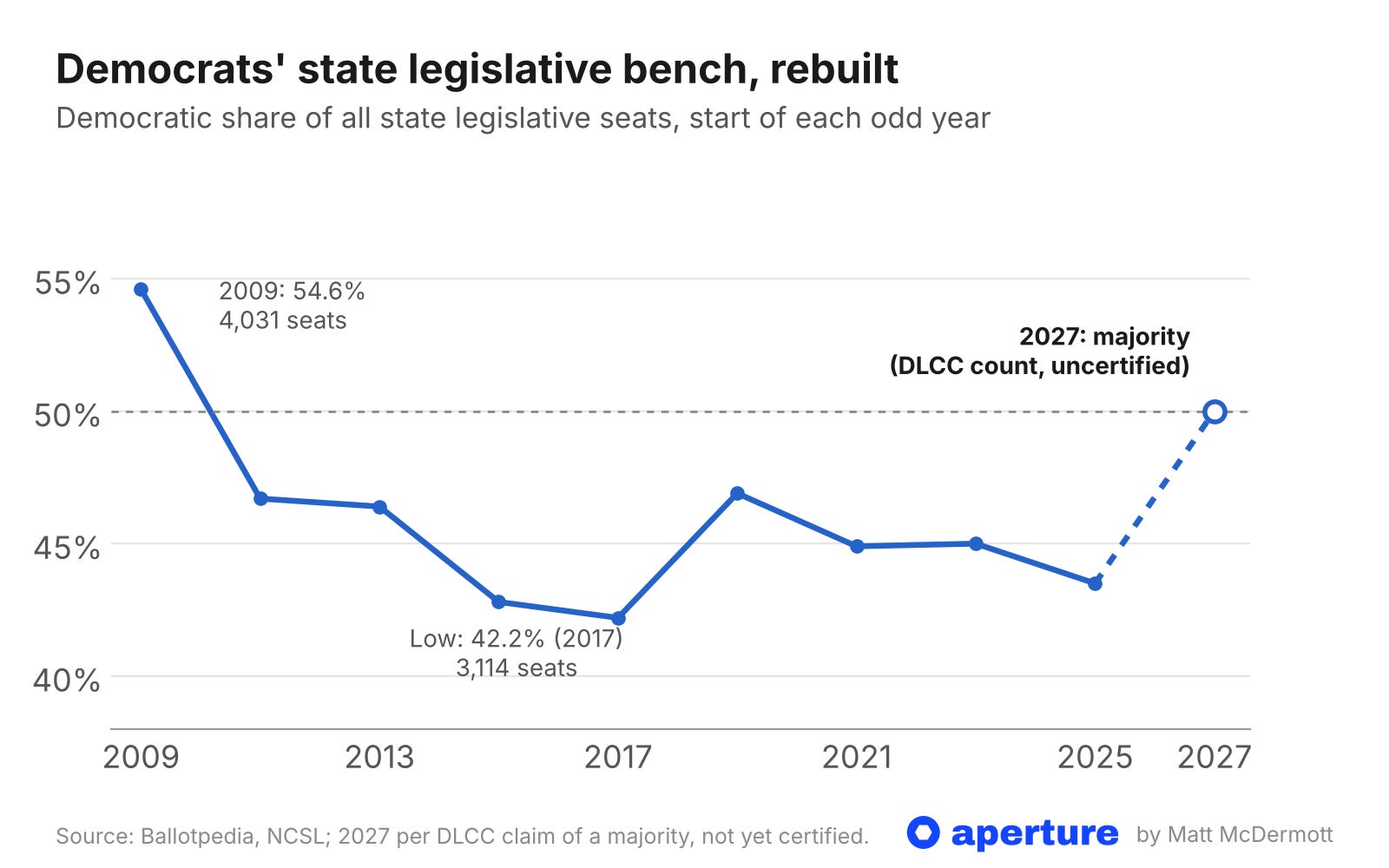
In 2009, Democrats held 4,031 state legislative seats, representing nearly 55% of all seats nationwide. By 2017, that number had collapsed to 3,114, just 42%.
Think about what that means. Nearly a thousand fewer Democratic state legislators building the experience, relationships, and fundraising networks necessary to run for higher office.
For years, Democrats weren’t simply losing elections in states across the country. They were losing the ability to compete.
Tuesday may have fundamentally reversed that trajectory.
According to preliminary Democratic Legislative Campaign Committee figures, Democrats are on track to hold at least 3,694 state legislative seats, potentially restoring a narrow national majority.
If those numbers hold, Democrats will have recovered roughly six out of every ten seats lost during the Obama years. And much of that recovery happened in one election.
And that’s before considering the new generation of statewide Democratic leaders elected Tuesday.
James Talarico and Gina Hinojosa in Texas. Keisha Lance Bottoms in Georgia. Amy Acton in Ohio. Rob Sand in Iowa. Scott Colom in Mississippi. Annie Andrews in South Carolina.
These aren’t just individual victories. They’re evidence that Democrats can compete across a much broader geographic map than conventional political wisdom has suggested.
And every one of those victories creates something the party didn’t have before: an incumbent with name recognition, a fundraising network, and a demonstrated ability to win.
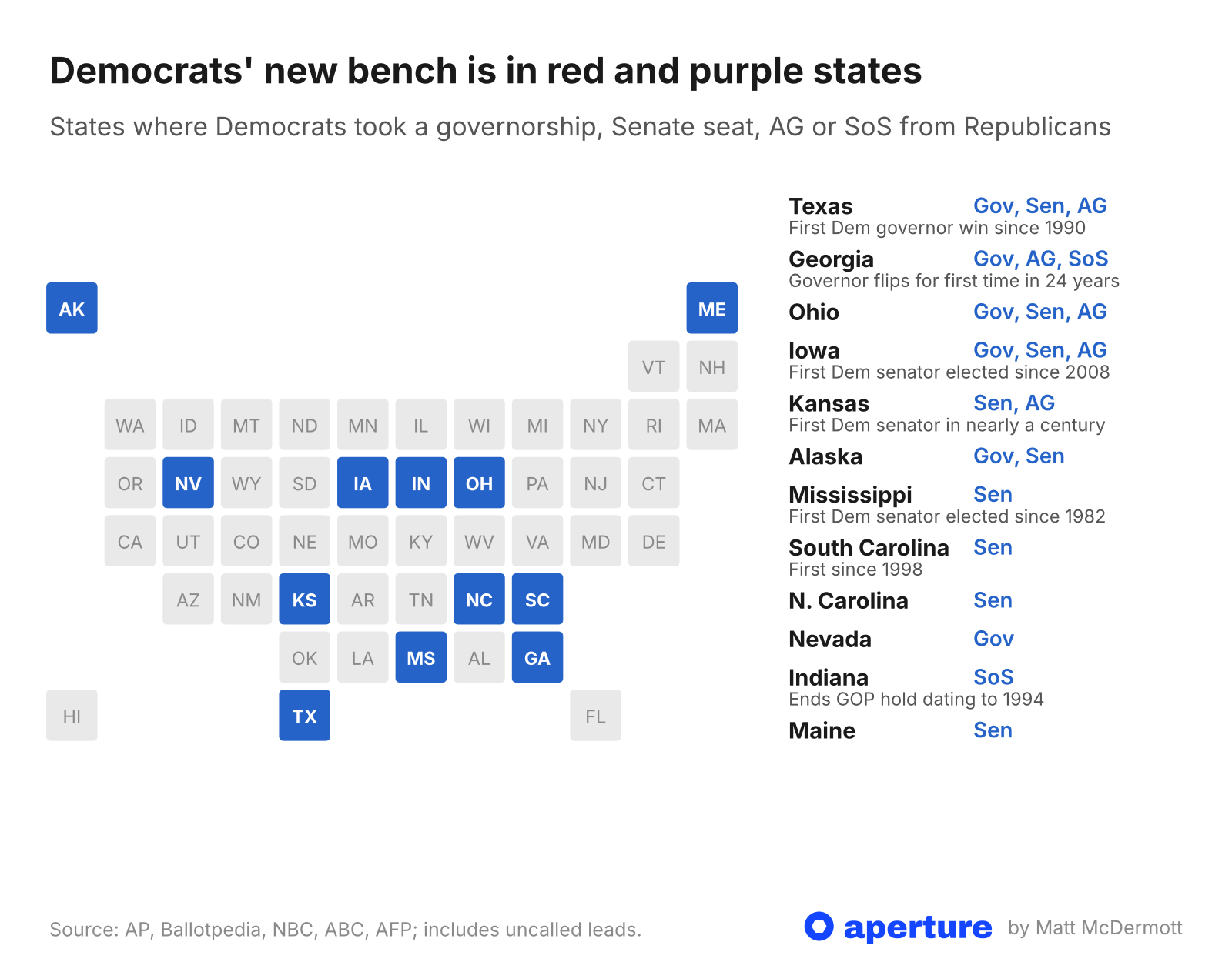
2010 destroyed the Democratic bench. 2026 may have rebuilt it.
Why 2026 isn’t simply 2018 all over again.
It’s a fair question.
Democrats won a substantial midterm victory in 2018, too. They captured the House, flipped seven governorships, and gained six legislative chambers.
But the difference is where those elections left the Democratic Party.
After 2018, Democrats still controlled fewer governorships, fewer legislative chambers, and fewer state government trifectas than Republicans.
They were rebuilding from a historic low, but Republicans retained the institutional advantage.
2026 is different because Democrats are crossing all three thresholds at once.
A majority of governorships. A majority of legislative chambers. And more state government trifectas than Republicans.
This isn’t simply an election where Democrats picked up seats.
It’s an election that has potentially changed which party controls the institutions of state government across the country.
And that creates opportunities that didn’t exist after 2018.
The road to 2030
There’s one important difference between 2010 and 2026 that shouldn’t get lost in this comparison.
Timing.
Republicans won their 2010 victories immediately before the next round of congressional redistricting. The governors and legislators elected that November were positioned to draw the maps that would shape elections for the following decade.
Democrats don’t have that same advantage in 2026.
The next census takes place in 2030. The officials responsible for drawing the next decade’s congressional maps will largely be determined by elections held that year.
So Tuesday’s victories don’t automatically hand Democrats control of the next redistricting cycle.
But they do give Democrats something important heading into it: incumbents, political infrastructure, fundraising networks, a larger bench of candidates, and potentially governing records that can help them defend those gains.
And before 2030 comes 2028.
The next presidential election will take place with Democratic governors in all seven of the previous presidential battlegrounds and Democratic secretaries of state in Arizona, Georgia, Michigan, and Nevada.
Those are meaningful changes in the institutional landscape surrounding the next national election.
The 2006 warning
There’s a historical counterargument to everything I’ve written here.
And it’s worth taking seriously.
In 2006, Democrats delivered a devastating midterm defeat to George W. Bush’s Republican Party.
They won both chambers of Congress, gained seven state government trifectas, and emerged with a majority of the nation’s governorships.
It looked like a political realignment.
Four years later, Republicans swept back into power in the states, reducing Democrats to just 11 trifectas.
The lesson is straightforward.
A midterm wave, even a historic one, doesn’t necessarily produce a lasting political transformation.
Voters can reject an unpopular president without permanently changing their partisan loyalties.
And Democrats’ success in 2026 doesn’t guarantee they’ll hold these new majorities in 2028 or 2030.
The 2010 Republican wave became historically consequential not simply because Republicans won, but because they extended their gains in subsequent elections and used the institutions they controlled to shape the political landscape.
Whether Democrats can do the same remains an open question.
But the opportunity is now there.
And that’s what makes 2026 so significant.
The election was Tuesday. The consequences are just beginning.
The lesson of 2010 wasn’t simply that elections have consequences.
It was that political power compounds.
A legislative majority can determine a congressional map. A governorship can shape the courts. An attorney general can influence how laws are defended. And a state legislator elected in one wave can become a governor, senator, or presidential candidate a decade later.
Republicans understood that.
They spent the better part of 16 years turning their 2010 victories into institutional advantages that outlasted individual elections, candidates, and presidents.
Now Democrats have an opportunity to do something similar.
But an opportunity isn’t a guarantee.
The governors elected Tuesday will have to govern. The new legislative majorities will have to deliver. And the candidates who broke through in Republican states will have to demonstrate that their victories represent something more durable than a backlash against Donald Trump.
Democrats will have to defend these gains in 2028 and 2030.
That’s when we’ll know whether 2026 was truly the beginning of a political realignment.
But one thing is already clear.
The Republican political order that emerged from 2010 did not survive November 3, 2026, intact.
And for the first time in a generation, Democrats have the opportunity to build something in its place.