


Democrats will enter the next Congress with 56 Senate seats, the largest majority either party has held in 16 years. They got there by flipping 9 Republican-held seats in a single night: Maine, North Carolina, Ohio, Texas, Iowa, Kansas, South Carolina, Mississippi and Alaska.
Most of the conversation since has been about defense, and how Democrats hold that majority in 2028.
That’s the wrong frame. The 2028 map gives Democrats as much reason to think about expanding their majority as protecting it, including a plausible path to a 60-seat supermajority.
Start with a simple fact. Since 2008, Democrats have won a Senate race in 43 states. Only 7 have stayed entirely out of reach: Idaho, Utah, Wyoming, Nebraska, Oklahoma, Kentucky and Tennessee.
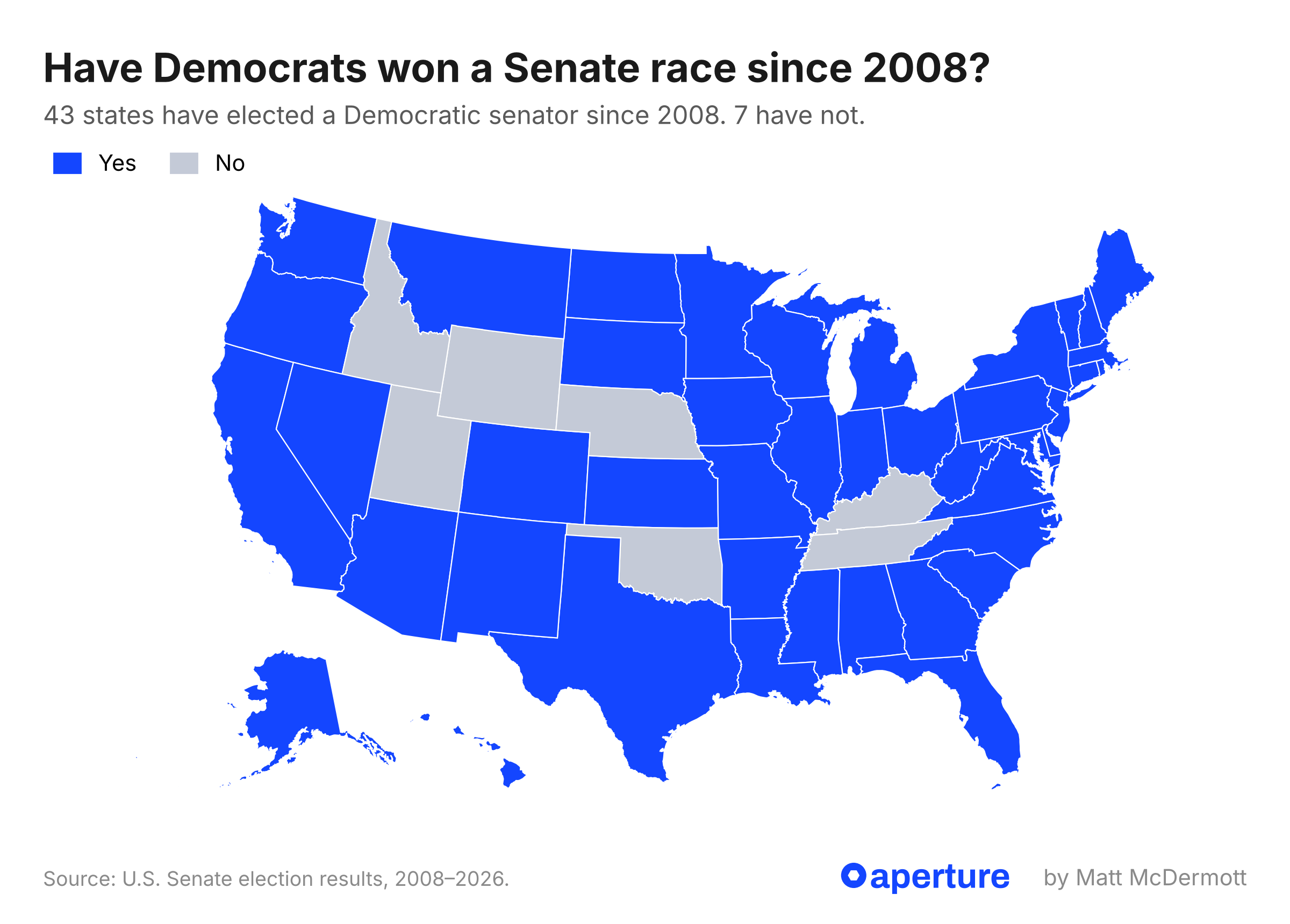
What’s striking about 2028 is that Democrats don’t need a 44th state to get to 60. They don’t even need a state they haven’t won in the last 4 years. Their path to a supermajority runs entirely through ground they’ve already had recent wining success.
Republicans face the opposite problem. Their path back to the majority runs through states where they haven’t won a Senate race in a decade or more.
60 seats is not a likely outcome of 2028. But the math is more favorable than the conversation suggests, and the decisions that determine whether Democrats get there need to be made now, long before anyone is nominated for president.
The math of a supermajority
Democrats need 4 more Senate seats to secure a supermajority in the Senate.
There are 35 Senate seats on the ballot in 2028: the 34 regularly scheduled Class III seats, plus a special election in Tennessee to fill the seat of Governor-elect Marsha Blackburn. Ohio is also back on the ballot after Sherrod Brown won a special election this year to complete JD Vance’s term.
Democrats hold 40 seats that aren’t on the ballot in 2028, and Republicans hold 25. Of the 35 seats that are, Democrats are defending 16 and Republicans 19. To reach 60, Democrats need to win 20 of those 35 races: hold all 16 of their own and flip 4, or lose 1 and flip 5.
4 seats is less than half of what Democrats flipped in a single election two weeks ago. And the most promising opportunities are in states Democrats just demonstrated they can win.
The 2028 Senate map runs through the 2026 Senate map
5 of the 19 Republican-held Senate seats on the ballot in 2028 are in states that just elected a Democratic senator: North Carolina, Alaska, Iowa, Kansas and South Carolina.
Add Wisconsin, which Donald Trump carried by less than a point in 2024 and where Tammy Baldwin won reelection the same year. Then add Florida, where Republican Senator Ashley Moody just survived by 2.9 points against an underfunded Democratic nominee.
That’s 7 potential pickup opportunities in states Trump carried by 18 points or less. 6 of them are states where a Democrat has won a Senate race since 2022.
That threshold matters. In 2026, Republicans defended 9 Senate seats in states Trump either lost or carried by less than 18 points. Democrats won 8 of them. The only exception was Florida.
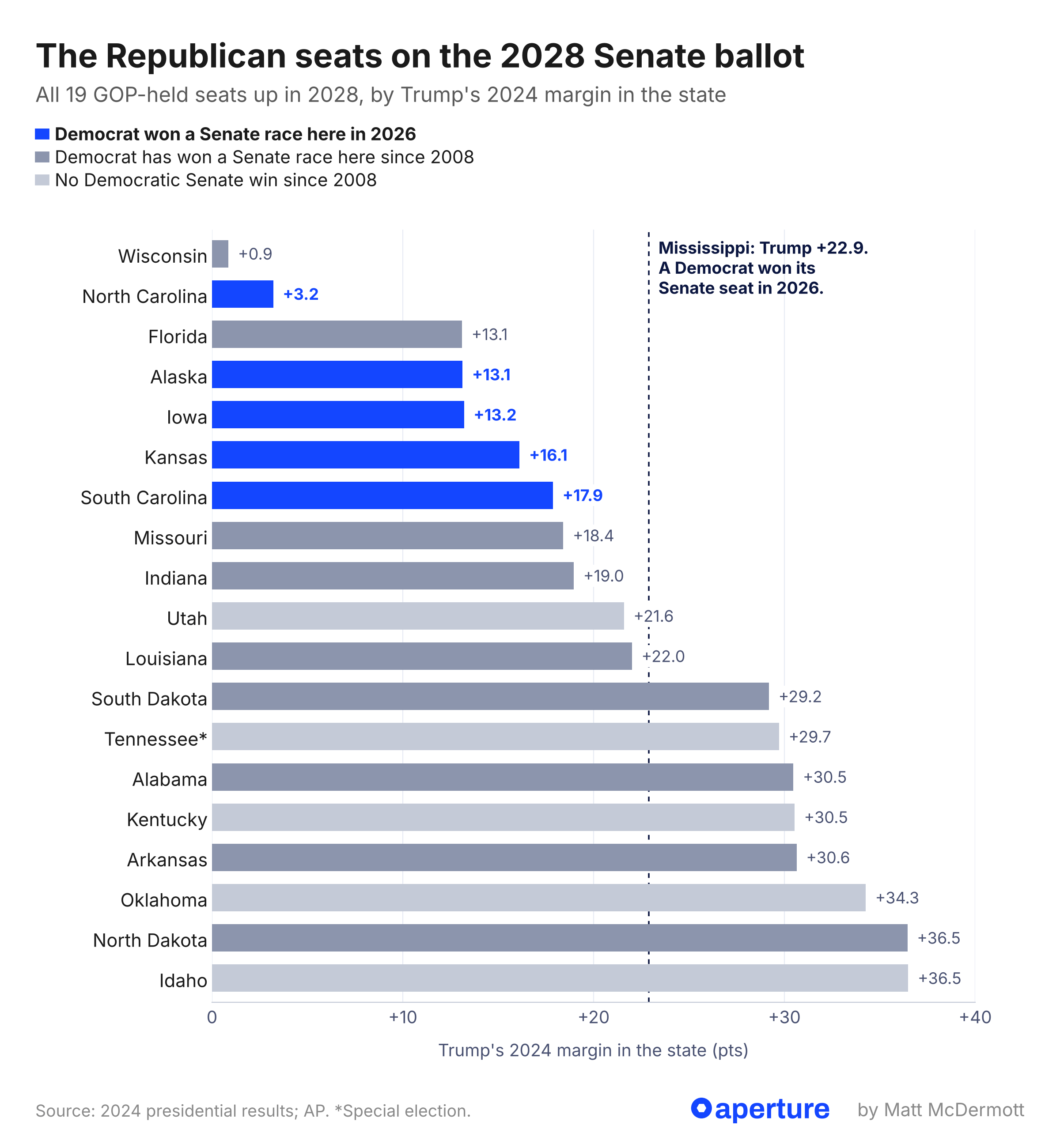
The opportunities extend beyond those 7 states. 14 of the 19 Republican-held seats on the ballot in 2028 are in states that have elected a Democratic senator since 2008. 11 are in states Trump carried by a smaller margin than Mississippi, where Scott Colom just became the first Democrat elected to the Senate since 1982.
Retirements could expand the map further. Chuck Grassley will be 95 years old on Election Day 2028. Ron Johnson has questioned whether he wants a fourth term.
How big a wave does it take to get to 60?
To understand what kind of national environment would put a Democratic supermajority within reach, I modeled the 2028 Senate races under 2 scenarios.
The first assumes a uniform swing from the 2024 presidential election. As the national environment moves toward Democrats or Republicans, every state moves by the same number of points.
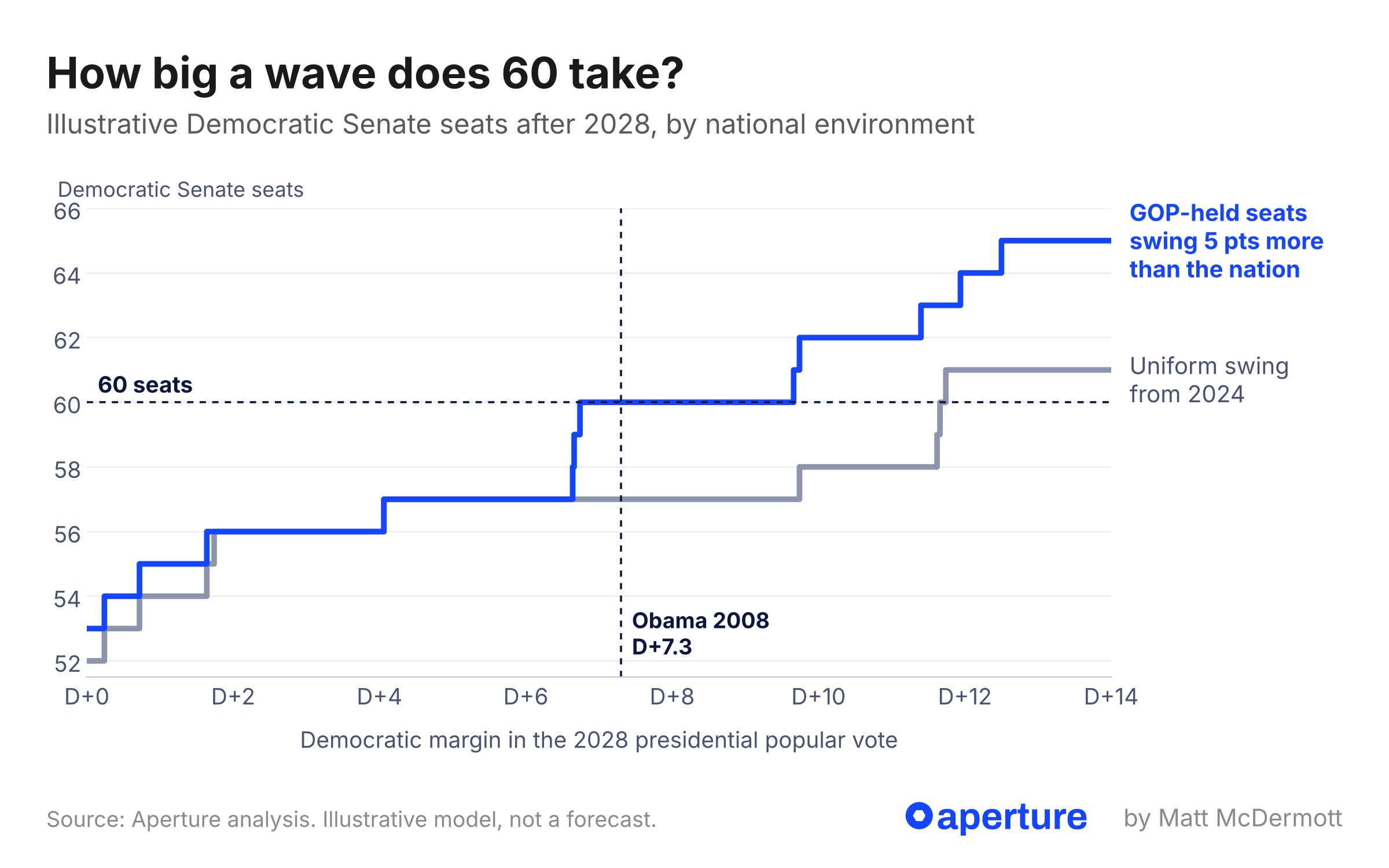
Under that scenario, Democrats don’t reach 60 seats until they win the national presidential popular vote by roughly 12 points. No presidential candidate has won by that margin since Ronald Reagan in 1984.
But one of the most consequential dynamics of 2026 is that the swing toward Democrats was not uniform. It was disproportionately large in Republican states.
Among states Trump carried by 10 points or more in 2024, the median swing toward Democratic Senate candidates in 2026 was 18.6 points. Among states Kamala Harris carried, it was 13.4 points.
Some of the biggest swings came in states long viewed as beyond Democrats’ reach. Texas swung 25.8 points toward Democrats, Mississippi 23.7, North Carolina 22.9, South Carolina 22.4 and Kansas 21.5.
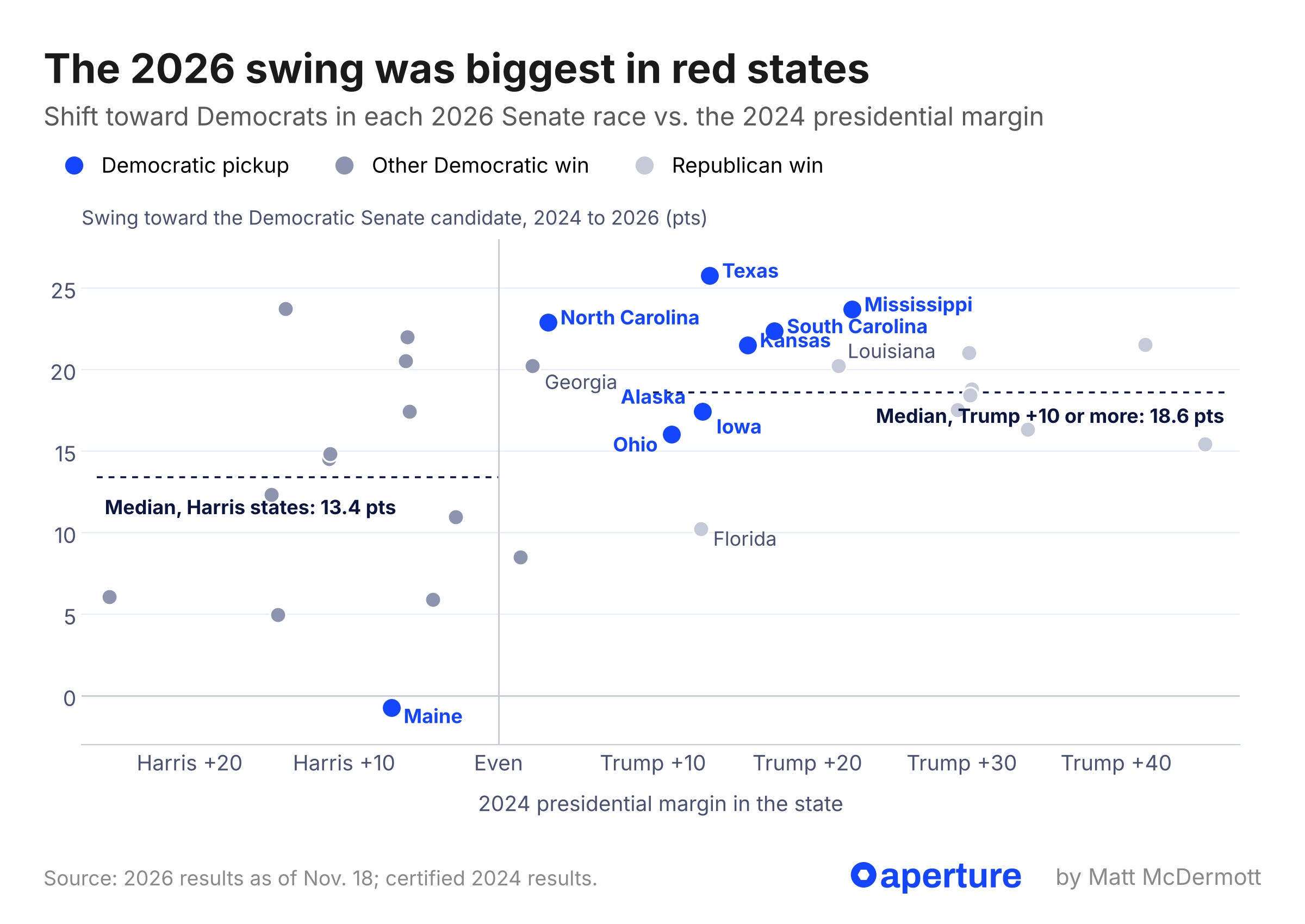
The second scenario asks what happens if that pattern partly holds: Democratic candidates in Republican-held seats outperform the national swing by an additional 5 points, roughly the 5-point gap that separated Trump states from Harris states this year.
Under that scenario, a 60-seat Democratic Senate comes into view in a national presidential environment of roughly D+7.
That’s not Reagan in 1984. That’s Barack Obama in 2008, who won the national popular vote by 7.3 points.
The 2008 comparison is instructive for reasons beyond the math.
In 2006, Democrats gained 6 Senate seats amid a backlash against an unpopular second-term Republican president. In 2008, with the White House open, they gained 8 more. The 60th seat came in 2009: Arlen Specter switched parties in April, and Al Franken was seated in July after a months-long recount in Minnesota.
The parallels to today are clear. Trump’s approval rating sits at 32% in the latest Reuters/Ipsos and Economist/YouGov polling. Democrats won the national House popular vote by 14 points. And Republicans enter the next presidential election without an incumbent on the ballot.
None of that guarantees a repeat of 2008. But it is a recent precedent for the kind of environment Democrats would need to build a Senate supermajority.
Needing to protect the 56
The pursuit of 60 depends on Democrats protecting the majority they already have. 6 Democratic-held seats warrant particular attention in 2028. 4 are in states Trump carried narrowly in 2024: Georgia (Raphael Warnock, Trump +2.2), Pennsylvania (John Fetterman, Trump +1.7), Nevada (Catherine Cortez Masto, Trump +3.1) and Arizona (Mark Kelly, Trump +5.5). New Hampshire (Maggie Hassan) is a state Harris carried by 2.8 points. And Ohio (Sherrod Brown) is a state Trump carried by 11.
Ohio is the most structurally vulnerable Democratic-held seat in the model. Brown just won his special election by 4.8 points, but he’ll have to do it again in a presidential-year electorate.
Pennsylvania presents 2 separate challenges. The electoral one is holding a Trump +1.7 seat amid real uncertainty about whether Fetterman runs again, faces a primary or retires. The legislative one is different: a 60-seat majority only functions as a supermajority if it votes as one, and Fetterman has broken with his party on high-profile votes. Democrats have an interest in resolving both early.
These are real vulnerabilities, and every Democratic-held seat lost raises the number of Republican-held seats Democrats need to flip. But it’s worth looking at the same map from the Republican side.
Republicans have a much harder path back
Starting from 44 Senate seats, Republicans need a net gain of 6 to reach a 50-50 Senate, which gives them control only if they also win the White House. They need a net gain of 7 for an outright majority.
The 6 most competitive Democratic-held seats are the ones above, and in 4 of those states Republicans haven’t won a Senate race in a decade or more. Their last wins came in 2016 in Arizona and Georgia, 2012 in Nevada and 2010 in New Hampshire. Only Ohio and Pennsylvania, where Bernie Moreno and Dave McCormick won in 2024, are states Republicans have won recently.
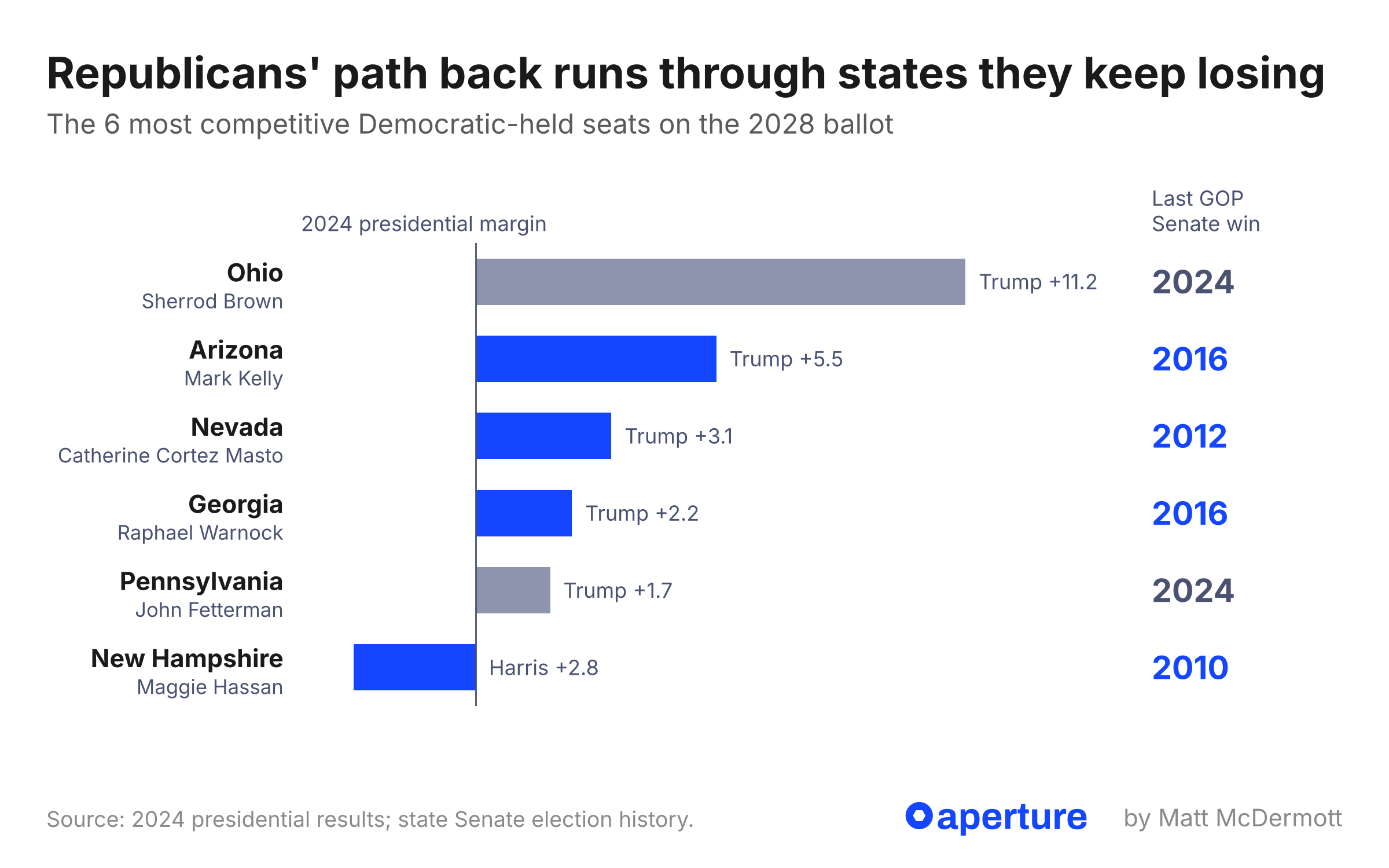
Sweeping those 6 seats gets Republicans to 50 only if they also hold all 19 of their own, including Wisconsin and North Carolina. Every Republican seat lost adds another Democratic seat they would need to take.
An outright majority without a Republican vice president would take a 7th pickup somewhere like Colorado or Illinois, 2 states Harris carried by roughly 11 points. Under the uniform-swing model, Republicans sweep the 6 most competitive Democratic-held seats in a national environment of roughly R+4. They don’t pick up a 7th until roughly R+12.5.
The asymmetry is striking. Democrats are 4 seats from a supermajority, with 5 immediate pickup opportunities in states they just won. Republicans are 6 seats from a 50-50 Senate, on a path that requires winning multiple states where they haven’t elected a senator in at least a decade.
For years, Democrats have been the party forced to overcome an unfavorable Senate map. In 2028, much of that structural disadvantage falls on Republicans.
Why 60 matters now
One of the more consequential conversations inside the Democratic Party since the midterms is about the purpose of winning in the first place. Winning the White House and a trifecta in 2028 is one objective. Building a governing majority capable of delivering meaningful change is another.
Democrats have lived the difference between a 60-seat Senate and a 50-seat Senate in recent memory. The former made the Affordable Care Act possible in 2009. The latter meant any single Democratic senator could derail major pieces of the party’s agenda in 2021 and 2022. Whatever the future of the filibuster, the size of a Senate majority shapes what a party can do with power.
There’s also a longer-term electoral consideration. The Senate seats on the ballot in 2030 are those elected in 2024. If Democrats win the presidency in 2028, they’ll defend their majority in the first midterm of a Democratic administration, a historically difficult environment for the party in power. Every additional seat won in 2028 is a cushion against that.
But the most important reason to set 60 as an objective is that ambition informs strategy.
Scott Colom’s race in Mississippi was rated Likely Republican heading into Election Day. National investment arrived late. Colom won by about 8,000 votes. Florida came within 3 points of electing a Democrat despite a comparatively underfunded campaign. Those results raise an obvious question about how many more opportunities emerge when Democrats treat these states as competitive in 2027 rather than discovering it in October 2028.
Building the map for 60
Getting to 60 depends on decisions Democrats make well before the presidential campaign takes shape.
The first is candidates. The defining feature of the 2026 Democratic Senate class was recruitment. Roy Cooper, Sherrod Brown, Mary Peltola, Adam Hamilton and James Talarico each brought a distinct political identity and a credible relationship with the voters of their states. The search for their equivalents in Wisconsin, North Carolina, Iowa, Alaska, Kansas, South Carolina and Florida should already be underway.
The second is timing. There’s an enormous difference between investing in a campaign a year out and buying television in October. Early money builds name recognition, fundraising capacity and field infrastructure, the foundation that makes a race competitive in the first place. The lesson of Mississippi and Florida is that those races were more competitive than the early investment in them.
The third is the presidential campaign itself. A campaign narrowly optimized around 270 electoral votes has little reason to invest in Iowa, Kansas, South Carolina or Alaska. A campaign trying to build a governing majority has every reason to. The 2028 coordinated campaign should be built for 60 Senate seats as well as 270 electoral votes.
The fourth is the brand. As I wrote last week, the Democratic label is considerably less of an obstacle in Republican states than many in Washington assume. All 9 Democratic Senate pickups this year came from candidates running as Democrats. The independent candidacies in Nebraska, Montana, South Dakota and Idaho all fell short.
The last is governing. Cost of living animated voters more than any other issue in 2026, and Democrats now control the Senate agenda for 2 years. The case for a larger majority in 2028 begins with what Democrats do with the one they have in 2027.
What could get in the way
There are good reasons to be cautious about extrapolating 2026 into 2028.
Midterms are imperfect predictors of presidential elections. Republicans swept Congress in 1994, and Bill Clinton won reelection comfortably 2 years later.
The electorate also changes in presidential years. Several post-election analyses find that differential turnout drove more of the 2026 wave than persuasion. J.L. Partners estimates that 35% of Trump’s 2024 voters skipped the midterms while 8% switched to Democrats, and attributes roughly 10 points of the 15-point swing to turnout. Broome Street Labs reached a similar conclusion in 12 of the 13 states it studied, with Texas the exception. Not every analyst agrees on the split, but if turnout was the bigger driver, a presidential electorate will bring many of those voters back and could shrink the outsized gains Democrats made in Republican states.
And Trump won’t be on the ballot. A Republican nominee who can hold his coalition while distancing from his administration’s unpopularity would present Democrats with a very different challenge.
The point of modeling a path to 60 isn’t to predict that 2026 repeats itself. It’s to understand what becomes possible if Democrats hold on to a meaningful share of what they just gained.
The case for ambition
A 60-seat Democratic Senate is not a prediction for 2028. It’s an opportunity Democrats should organize around.
What makes that opportunity so extraordinary is that the path runs through states where Democrats have already demonstrated an ability to win. A year ago, few would have identified Kansas, Iowa or South Carolina as central to the future of Democratic power in Washington. Today, all three are represented by newly elected Democratic senators.
That should change how Democrats think about the next election.
Political maps aren’t static. They’re shaped by the candidates parties recruit, the communities they invest in and the arguments they make to voters. The results of 2026 demonstrate just how much electoral opportunity exists beyond the traditional battlegrounds.
The ambition for 2028 should extend beyond winning back the White House and protecting a Senate majority. It should be to build the largest governing majority Democrats have held in a generation.
The electoral map offers that possibility. The decisions Democrats make over the next two years will determine whether they realize it.
We need more of this optimistic yet realistic thinking. The Trump era has been so demoralizing that many Dems fixate on structural imbalances that favor Republicans. There are obvious problems with the electoral college, the Senate, and gerrymandering House seats, but you play the cards you’re dealt. We can do this.
Of course Trump not being on the ballot cuts both ways. If his low propensity base becomes politically demobilized we might well revert to an electorate that looks a lot like 2012. Which would be a significant boon to democrats given how voters have realigned since then, though still not as friendly as the 2026 electorate was.
The real bull case though would be that Trump stays on TV turning off independents voters, college educated etc. while staying off the ballot, and thus losing the low propensity Trump voters. That's probably the best scenario for a supermajority without the economy crashing.