


For two years, a compelling theory took hold in Democratic politics: if the party’s brand is toxic in red states, stop running Democrats. Clear the field for an independent. Find a union leader, a veteran, a university president. Take the D off the ballot, and maybe they can reach Trump voters a Democrat never could.
It wasn’t a crazy idea. It had a proof of concept. In 2024, Dan Osborn ran as an independent in Nebraska and lost to Deb Fischer by 6.7 points in a state Trump carried by 20. On the same ballot, the Democratic nominee in Nebraska’s other Senate race lost by 25. An 18-point gap between two challengers in the same state on the same day is not noise. As a pollster, I’d have taken that seriously too.
And it wasn’t a fringe idea. In March 2025, political scientists Michael Bailey and Lee Drutman argued in The Bulwark that Democrats should step aside in red states altogether. “The brand is toxic in too many places,” they wrote, and the chance of Democrats winning back the Senate within a decade was “vanishingly small.” Weeks later, Split Ticket mapped where Democrats should run “strategic independents,” noting that Osborn and Utah’s Evan McMullin had posted some of the strongest challenger performances of the modern era. By that fall, The American Prospect was making the case that for red-state populists the Democratic label was simply toxic, and E.J. Dionne floated what he called a “heretical thought”: that where the brand is badly broken, independents might have a better shot (via The Democratic Strategist).
By 2026, the theory was being put into practice. Democrats stepped aside for independent Senate candidates in Nebraska, Idaho and South Dakota. In Montana, much of the Democratic establishment, including Jon Tester, backed independent Seth Bodnar. In Alaska, the Democratic House candidate dropped out to support an independent. Another independent was recruited in Nebraska’s 1st District before exiting the race.
Then voters weighed in. One election, particularly a Democratic wave, can’t settle every question about when an independent candidacy makes sense. But the results make it awfully hard to argue that the Democratic label was the obstacle in red states. And they raise a bigger question: what if the shortage of credible local Democrats helped make the brand so weak in the first place?
You can’t rebuild a political brand by refusing to run under its name.
The scoreboard
The four independent Senate candidates went 0 for 4. Osborn lost Nebraska. Bodnar lost Montana. Todd Achilles lost Idaho by 23 points, and Brian Bengs lost South Dakota by 21. In Alaska’s House race, independent Bill Hill trails by about 9 points in first-choice votes, with ranked-choice tabulation still ahead.
Meanwhile, candidates running as Democrats did things nobody thought possible a year ago. Adam Hamilton, a Methodist pastor, beat an incumbent senator in Kansas, the first Democratic Senate win there since 1932. James Talarico won Texas by 12. Annie Andrews flipped South Carolina. Josh Turek flipped Iowa. Sherrod Brown won back an Ohio seat. In Mississippi, Scott Colom unseated Cindy Hyde-Smith, and in Alaska, Mary Peltola is expected to unseat Dan Sullivan as the final ballots are counted. In western Montana, a smokejumper named Sam Forstag flipped Ryan Zinke’s old House seat. In Kansas, Cindy Holscher won the governor’s race, holding the office for Democrats.
These aren’t swing states. Trump carried Kansas by 16 points, South Carolina by 18 and Mississippi by 23. The D was supposed to make winning impossible. It didn’t.
Apples to apples
There’s an obvious objection: the independents ran in tougher states. Idaho voted for Trump by 36 points. Nobody should expect Todd Achilles to win there.
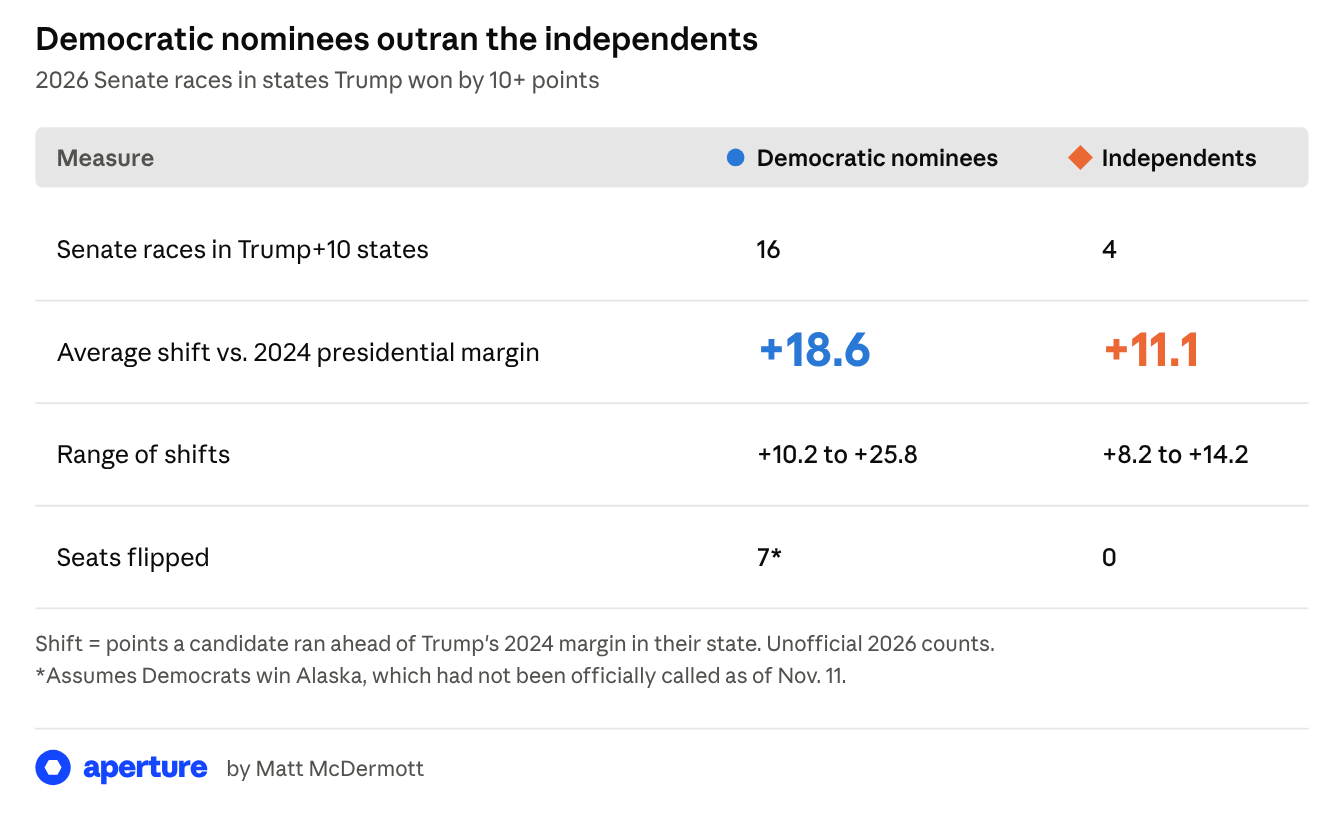
So compare the candidates against a common baseline: Trump’s 2024 margin in each state. How far did each Senate candidate run ahead of that mark? It doesn’t erase differences in incumbency, candidate strength, spending or demographics. But it gives us a more meaningful comparison than wins and losses alone. And the gap is substantial.
For perspective, Bailey and Drutman argued in 2025 that even if Democrats improved on Harris’s margin by 6 points, only Maine and North Carolina would be competitive. In these red-state races, Democrats improved by roughly three times that amount and flipped seven seats in states Trump had carried by double digits.
Now look at the deepest-red states. Democrats ran Senate candidates in nine states Trump carried by at least 20 points: Louisiana, Mississippi, Alabama, Arkansas, Kentucky, Tennessee, Oklahoma, West Virginia and Wyoming. Their average improvement over Harris was 19.2 points. Even the weakest Democratic performance, in Wyoming, exceeded the strongest independent: 15.5 points versus Osborn’s 14.2.
Nine for nine. Even in Wyoming, Trump’s strongest state, the Democrat outperformed the most celebrated independent in the country against the 2024 baseline.
The Deep South makes the point sharper. Split Ticket’s own analysis found independents struggle with Black and Hispanic voters, for whom the Democratic label does real work on turnout and persuasion, and it judged much of the Deep South off-limits to the independent model. Under their own label, Democrats nearly won Louisiana and won Mississippi.
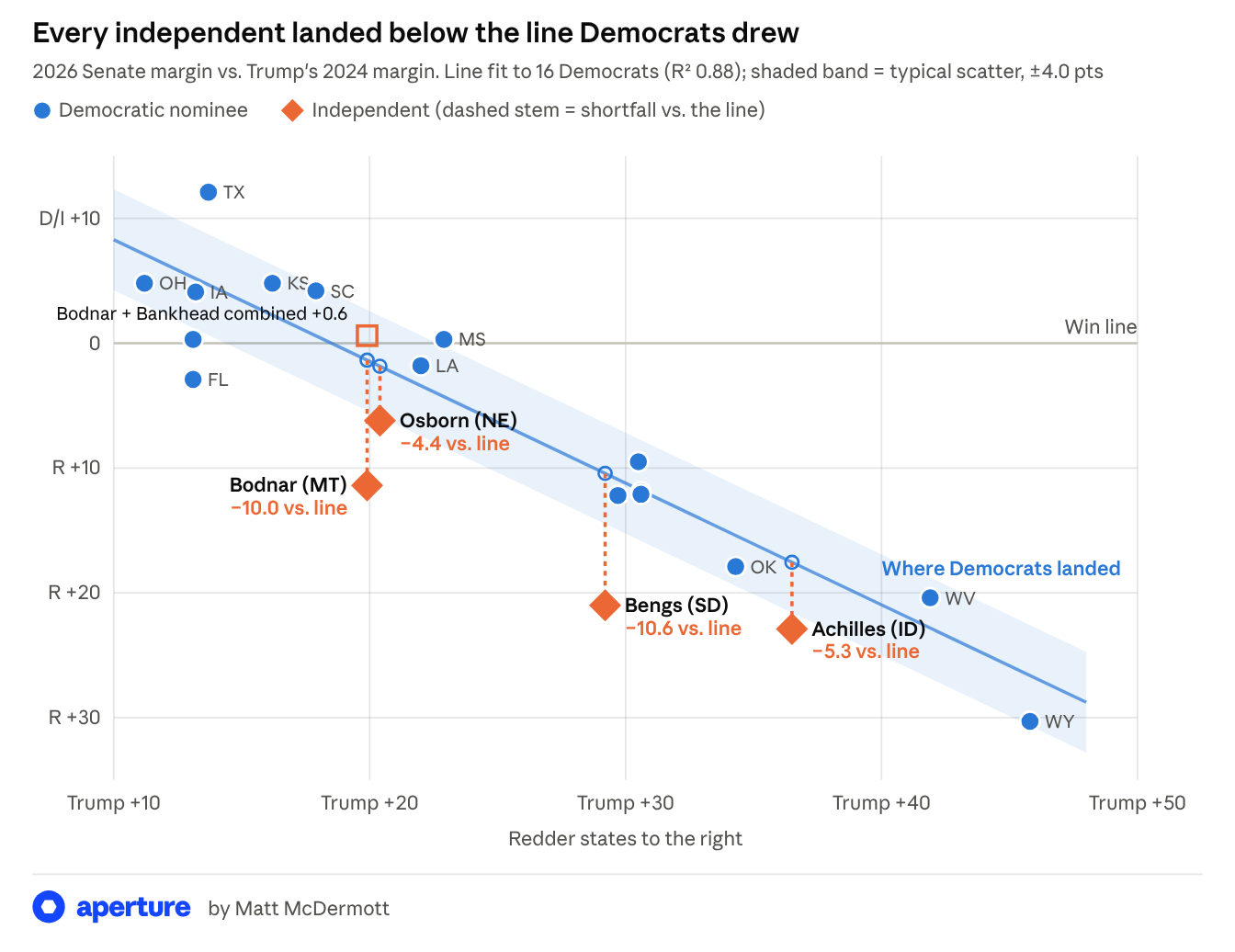
The scatterplot tells the story. Draw a line through the 16 Democratic Senate results, and the relationship is remarkably consistent: an R² of 0.88, with typical variation of about 4 points. All four independents fall below it.
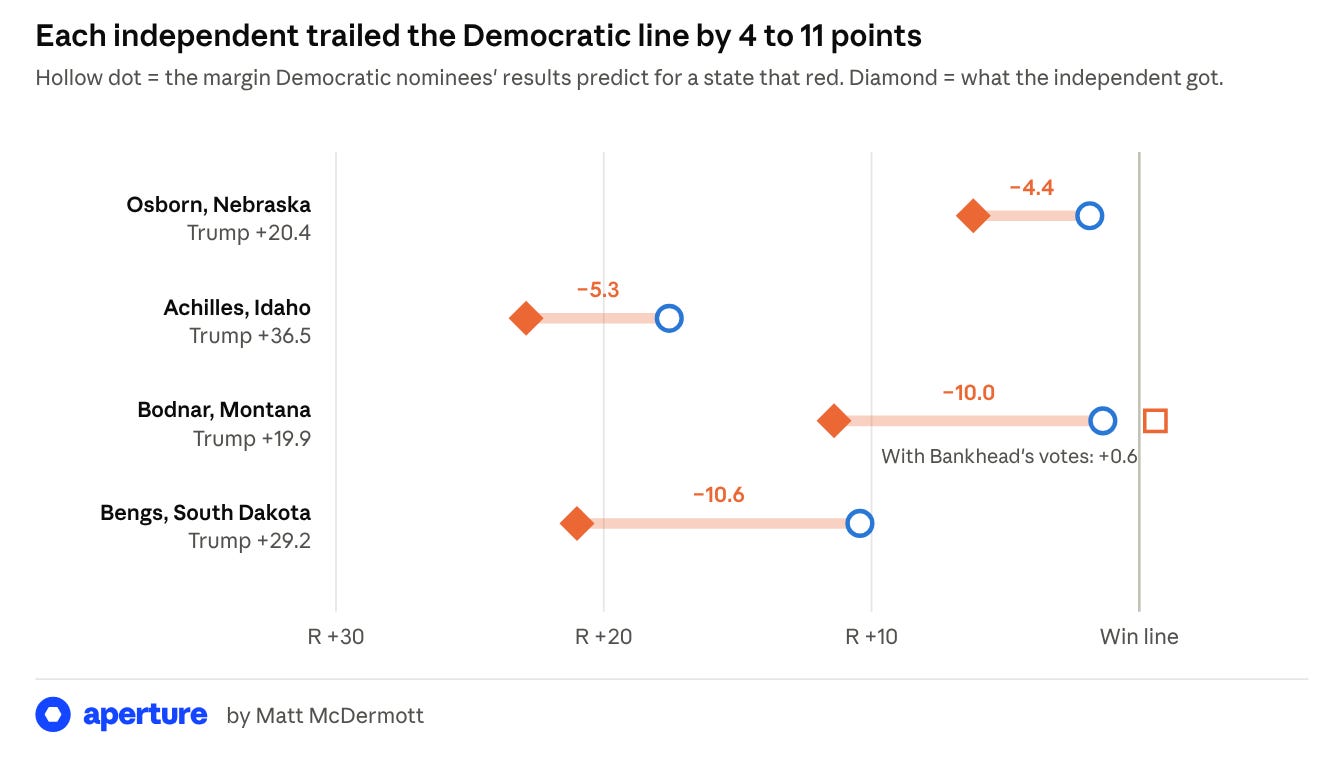
Osborn came closest, finishing about four points below where Democrats tended to land in states as red as Nebraska. Bodnar and Bengs were about ten points below. That’s not proof Osborn would have done better with a D next to his name. It isn’t a causal estimate of the label’s value. But it is powerful evidence against the claim that running as a Democrat was the problem.
What Nebraska actually shows
To be fair, Nebraska offers some potential evidence for the other side.
In Nebraska’s 1st District, Osborn won by 2.9 points while Democrat Chris Backemeyer lost the House race by 3.5 on the very same ballots. Osborn received about 5,400 more votes than Backemeyer, while Pete Ricketts received roughly 10,700 fewer than Mike Flood. Some voters backed Flood for the House and Osborn for the Senate. That’s precisely what the independent strategy was designed to accomplish.
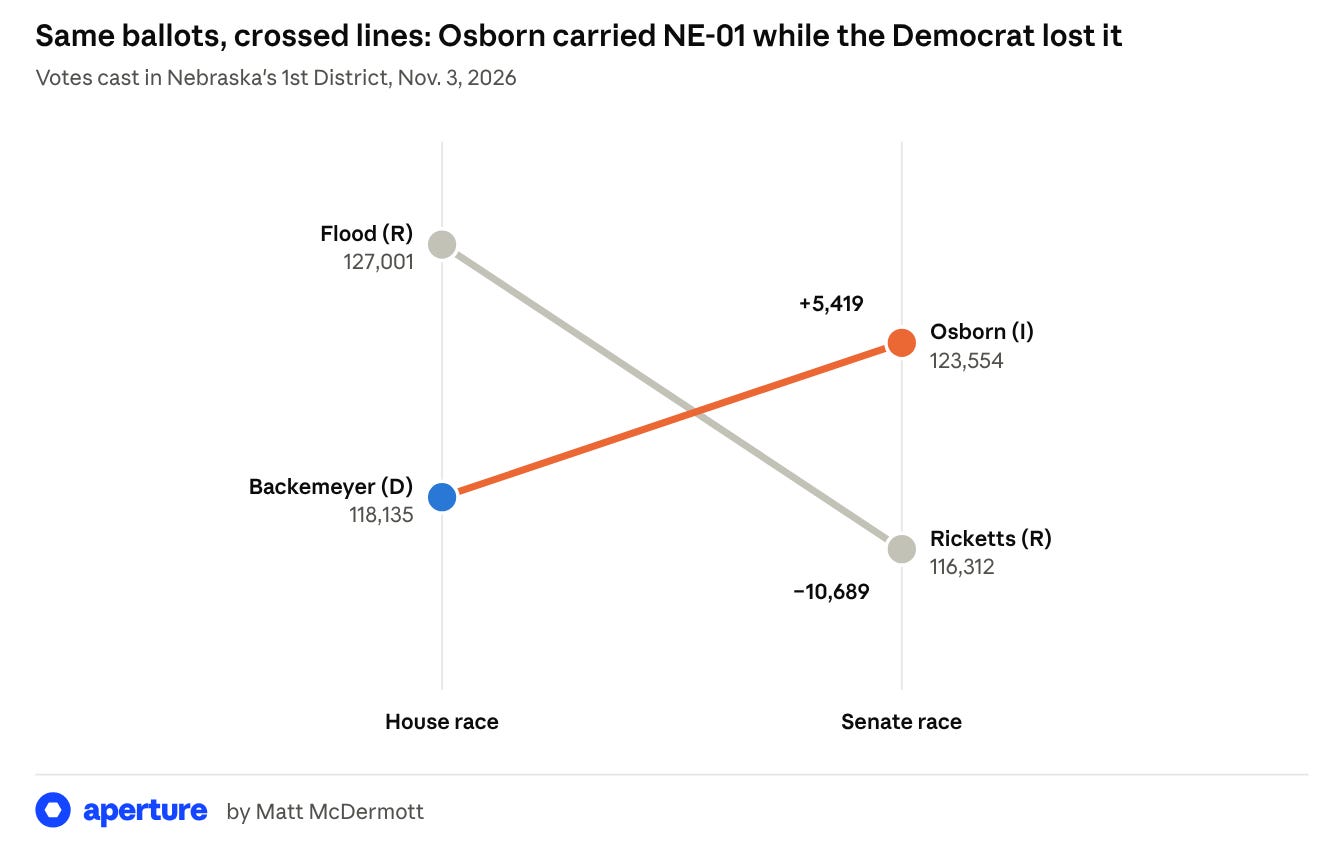
But statewide, the picture is different. Osborn lost to Deb Fischer by 6.7 points in 2024 and to Pete Ricketts by 6.2 in 2026. Those are different opponents, so it isn’t a perfect comparison. Still, while Democrats in red states ran nearly 19 points ahead of the 2024 presidential baseline, Osborn’s margin barely budged.
That’s the trade-off. Running as an independent can shield a candidate from the Democratic brand in a bad year. But it can also limit the upside when voters swing toward Democrats. The insurance worked in 2024. In 2026, the premium looked a lot more expensive. Osborn could outperform a Democrat on the same ballot, but he didn’t ride the Democratic wave the way Democratic nominees did elsewhere.
The cost nobody priced in
Montana exposes a cost that doesn’t get nearly enough attention: the independent strategy only has the chance of working if and when Democrats agree not to run a candidate of their own.
Alani Bankhead won the Democratic primary and stayed in the race. Bodnar had the money, the endorsements and Jon Tester’s backing. Republican Kurt Alme won with 48.8%. Bodnar received 37.4%, and Bankhead took 12%. Together, the two non-Republicans won more votes than Alme.
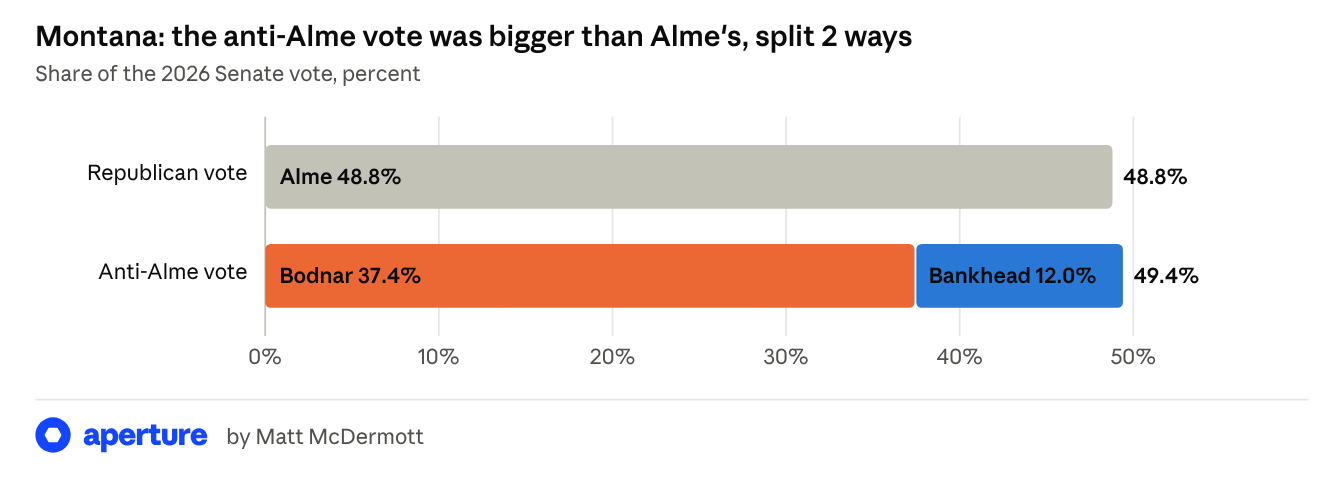
That doesn’t mean Bodnar would have won a two-way race. Votes don’t transfer automatically. But the split may have cost Democrats a Senate seat in a year when they were winning in even redder states. And on the same ballot, Democrat Sam Forstag flipped western Montana’s House seat.
The bigger issue isn’t the math. It’s what the strategy asks of the party. Who gets to decide that Democrats shouldn’t nominate a Democrat? What happens when primary voters disagree? Who controls the money, the voter file and the field operation? And why should an ambitious young Democrat spend years building a career in a party that might decide not to put its own candidate on the ballot?
In Idaho and South Dakota, the Democratic nominees stepped aside. In Montana, Bankhead didn’t. Any strategy that depends on your own voters and candidates quietly getting out of the way is fragile from the start. Either way, the party pays a price.
There’s another cost. That doesn’t mean Bodnar would have won a two-way race. Votes don’t transfer automatically. But the split may have cost Democrats a Senate seat in a year when they were winning in even redder states. And on the same ballot, Democrat Sam Forstag flipped western Montana’s House seat.
The bigger issue isn’t the math. It’s what the strategy asks of the party. Who gets to decide that Democrats shouldn’t nominate a Democrat? What happens when primary voters disagree? Who controls the money, the voter file and the field operation? And why should an ambitious young Democrat spend years building a career in a party that might decide not to put its own candidate on the ballot?
In Idaho and South Dakota, the Democratic nominees stepped aside. In Montana, Bankhead didn’t. Any strategy that depends on your own voters and candidates quietly getting out of the way is fragile from the start. Either way, the party pays a price.
There’s another cost. Spending on a Democratic Senate campaign can help build the entire ticket, through coordinated organizing and support for legislative and down-ballot candidates. An independent campaign isn’t designed to do that. Too often, the infrastructure disappears when the candidate does.
A party that outsources its top-of-ticket races outsources the infrastructure that comes with them.
An unpopular brand still beat no brand
Here’s what Democrats should take from this: the party didn’t fix its brand before Election Day. It won anyway.
Voters leaving the polls last week still viewed the Democratic Party more negatively than positively: CBS News’s exit poll found just over half had an unfavorable view of it. Hardly a rebuilt brand. But it was still preferred to the alternative. Gallup’s September survey of all U.S. adults had 43% viewing Democrats favorably, compared with 35% for Republicans. Among independents it was 40% to 27%.
That’s the point. A party doesn’t need to be universally popular to win. It needs to be the better choice. Elections are comparisons. A Democrat on the ballot gives voters a clear way to register their dissatisfaction with the party in power. An independent has to make a different case, one centered on the individual candidate. In a midterm shaped by an unpopular Republican president, that distinction matters.
The case for independents wasn’t irrational. It assumed the Democratic label was a liability, so candidates should shed it. But a label that hurts in one election can help in the next. In 2026, the candidates who kept it were better positioned to benefit from the backlash against Republicans.
Who gets to define a Kansas Democrat
The stakes go well beyond one election. The Democrats who just won in red states now have a chance to redefine what it means to be a Kansas Democrat or a Texas Democrat. That may be as consequential as anything they accomplish in office over the next several years.
An independent senator can change how voters see that senator. A Democratic senator from Kansas can change how voters see Democrats in Kansas.
I spend a lot of time in focus groups listening to voters describe political and consumer brands. Their impressions aren’t built only by national advertising. They’re shaped by the people they associate with the name. For years, Republicans and national media have had an outsized role in defining what a Democrat looks like in red states, in part because there have been so few prominent local Democrats offering a different example. When a brand has no local faces, its opponents get to define it.
Consider Kansas. One version of the Democratic Party is the one voters see on cable news: presidential candidates, congressional leaders and the latest national controversy. Another is the governor, senator, mayor or state legislator whose work they can actually judge. Those experiences aren’t interchangeable. A party can be unpopular nationally and credible locally. Kansans have had nearly eight years of a Democratic governor, and they’ve just elected another one. In many red states, voters have had far fewer local examples to draw on.
That’s why these victories matter beyond the seat count. They give voters a closer, more tangible example of what a Democrat can be.
Now there are more of those examples: a Methodist pastor in Kansas, a former teacher and state legislator in Texas, a district attorney in Mississippi, a smokejumper in western Montana. Each has a chance to redefine the party for voters in their own state. That’s how you rebuild a brand: not by hiding it, but by giving people a reason to see it differently.
Of course, winning is only the opening. Rebuilding the brand means governing well, remaining rooted in the community and turning personal support into something that lasts beyond one candidate. A Democrat who wins while constantly distancing themselves from the party may not do much to strengthen it.
An independent victory doesn’t build that same Democratic foundation. Even if Osborn had won, Nebraska would still lack a new Democratic senator to help recruit candidates, strengthen the bench and give voters a visible example of the party. A Democrat who wins and governs well can make the next Democratic victory easier. An independent can do the same for future independents. Those are very different long-term outcomes.
Build the brand you have
The independent experiment wasn’t foolish. Nebraska showed that a strong independent can attract voters who won’t back a Democrat on the same ballot. But 2026 gave the strategy its biggest test in an unusually favorable environment for Democrats, and independents underperformed Democratic nominees against a common partisan baseline. That doesn’t rule out independents in every circumstance. It does undercut the argument that the D was the problem.
The Democratic brand isn’t healthy. Nobody should pretend otherwise. But in a two-party system, it’s still an asset worth rebuilding. That means recruiting candidates who fit their states, running them as Democrats and giving voters a chance to see what the party can deliver where they live.
The independent strategy treats the brand as something to escape. A party-building strategy treats it as something to improve. One is focused on a single race. The other changes the ground on which future races are fought.
Democrats proved they can win in Kansas, Texas, South Carolina and western Montana. Now comes the harder part: turning those victories into a stronger party, so the next Democrat doesn’t have to start from scratch or let Republicans define them first.
This is so cynical. Better plan: be who you are, and sell your vision. Don’t fucking back down from a fight! People aren’t stupid, generally.
Thank you. I've been thinking about writing a post similar to this. Glad to see it out there and with data to back up the point.
When I first got into politics in a Republican area of upstate NY I was told not to say I was a Democrat, not to put it on signs or literature. I strongly disagreed. Running away from the party is weak and self-defeating. It might take multiple cycles but you do the work, do the organizing, build the trust, and you win in unlikely seeming places.